Skip to content
The differences between Mobil 1 High Mileage (HM), Extended Performance (EP), and Advanced Fuel Economy (AFE) come down to their additive packages, intended oil change intervals (OCIs), and viscosity ranges.
Mobil 1 High Mileage (HM) targets older engines with over 75,000 miles. It includes seal conditioners to prevent leaks and extra anti-wear additives to address consumption issues common in higher-mileage vehicles. This is critical because aging seals can shrink and harden, leading to oil seepage. HM formulations work well for standard OCIs of 5,000 to 10,000 miles. Available viscosities include 0W20, 5W-20, 5W-30, 10W-30, and 10W-40, with HM oils running slightly thicker than AFE within the same grade range.
Mobil 1 Extended Performance (EP) is engineered for maximum drain intervals, offering guaranteed protection up to 15,000 miles or one year (some formulations go to 20,000 miles). It uses a robust additive package with a higher Total Base Number (TBN) to neutralize acids that build up during extended service. If you’re planning shorter OCIs around 5,000 to 7,500 miles, the premium cost of EP may not be justified. That said, EP 0W-20 remains a premium choice for those seeking top-tier protection.
Mobil 1 Advanced Fuel Economy (AFE) focuses on low-viscosity formulations (0W-16, 0W-20, 0W-30) designed to maximize fuel efficiency. The thinner oil flows faster during cold starts, reducing wear and stress on the starting system. AFE can deliver up to a 2 percent fuel economy improvement compared to higher viscosity grades. It’s certified as “Resource Conserving” and is often the least expensive Mobil 1 variety, making it suitable for standard 5,000 to 10,000 mile intervals.

Mobil 1 High Mileage Vs Extended Performance Vs Advanced Fuel Economy: Key Things In Common
See Also: Pennzoil Vs Mobil 1: Head-To-Head Comparison
HM, EP, and AFE: Key Differences
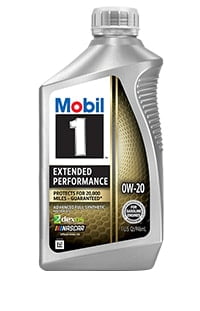
Mobil 1 Extended Performance
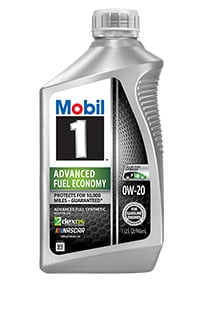
Mobil 1 Advanced Fuel Economy
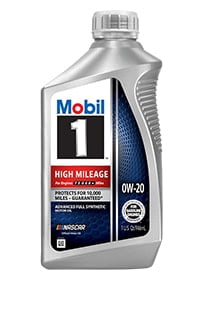
Mobil 1 High Mileage
As the names of these products suggest, each was designed to meet specific engine needs. Here, I’ll be doing a comparative analysis of all three variants based on particular features. Take a look!
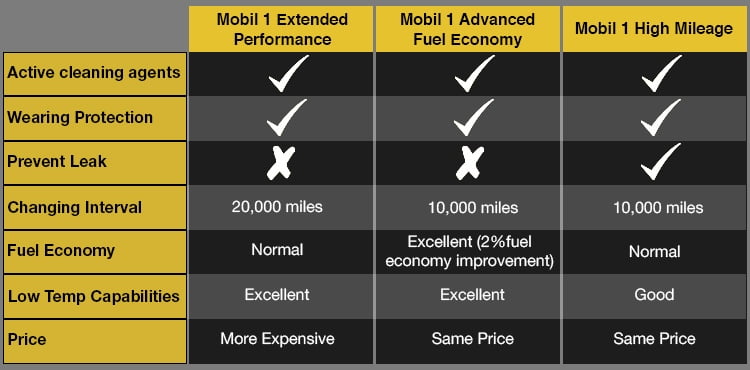
Key Distinguishing Features
Mobil 1 Advanced Fuel for A Better Fuel Economy
Mobil 1 Advanced Fuel Economy
Mobil 1 claims that with this product, any standard passenger car with a 20-gallon fuel tank can travel nine additional miles on a full tank of gas when using Mobil 1 Advanced Fuel Economy. That equates to roughly 2% better efficiency than standard engine oils.
However, this feature depends on various factors like engine type, age of the vehicle, driving conditions, ambient temperature, and the viscosity of your current engine oil. Many people are still skeptical about this.
From my personal experience, I have tried this product for my sister’s car, but I recognized no change in terms of minimizing fuel usage. Many car owners state that this product is a marketing strategy by Mobil 1 for their 0w product. Somehow I think it’s right.
Mobil 1 High Mileage For Preventing Leaks
Designed for vehicles with over 75,000 miles on the ODO, Mobil 1 High Mileage engine oil contains a blend of additives that conditions old seals to combat leaks and prevent excessive sludge deposits. The lubricant has a higher base oil viscosity that delivers better temperature protection, extending the engine’s life expectancy.
Yes, I must say that this stuff is excellent in preventing leaks. With high levels of Zinc and seal conditioners, Mobil 1 High Mileage is a perfect choice to keep the engine gaskets or seals in good shape. Besides, some car owners reveal that their cars start quieter since they use this fluid.
In a nutshell, this product stands out as a good choice for high mileage vehicles. It’s not a marketing gimmick.
Mobil 1 Extended Performance for Low-temp Applications & Long-Lasting
Mobil 1 Extended Performance
The Mobil 1 Extended Performance engine oil uses a proprietary blend of synthetic base stocks and precisely balanced additives to protect the engine during extended use. The excellent low-temperature capabilities of the lubricant offer quick protection even when used at -40°C.
In terms of long-lasting, Mobil 1 claims that this fluid can extend the interval up to 15,000 miles. If you have any engine failure, they will cover you under the oil warranty. This makes the product more trustworthy, and customers are more comfortable when using it. A plus point for Mobil 1! But I don’t know how they can diagnose the problems and cover the warranty.
Moreover, some car manufactures have a maintenance schedule that tells you when to change the oil. Will you stretch the changing interval as Mobil 1 offers or follow the maintenance minder?
Changing Interval
One amazing feature of all three products is the ability to protect engine life between oil change intervals. The ability of each product, however, differs:
See Also: Valvoline Vs Mobil 1: Head-to-Head Comparison
Mobil 1 Advanced Fuel Economy vs High Mileage
Mobil 1 Advanced Fuel Economy
Mobil 1 High Mileage
Mobil 1 advanced fuel economy vs high mileage share the same period. These two oil types can last up to 10,000 miles between change intervals. It does this by regulating the oxidation rate such that the engine doesn’t break down before you get a chance to change the oil.
Despite the shorter draining intervals, Mobil 1 Advanced Fuel Economy and High Mileage are excellent engine oils. Since they’re designed for specific applications, they must be replaced sooner for maximum efficiency.
Mobil 1 Extended Performance
Mobil 1 Extended Performance
The Extended Performance Oil variant, on the other hand, does it better. It gives you the luxury of 20,000 miles between change intervals. And it does this by controlling the temperature, cleansing the engine, preventing metal-on-metal friction, and regulating the oxidation rate.
Infrequent oil change intervals help reduce carbon emissions, save on service bills, and reduce the time spent driving to and from the repair shop. If you are lucky, you will save a few bucks. If you are not that lucky, you have to pay your dealer or your mechanic.
Approval
All three variants of the Mobil 1 motor oil are good and can suit almost all engines. Nevertheless, they are best used on certain car brands and engine types.
Here are a few engine & viscosity recommendations that I would like you to take into consideration when buying these products:
● Mobil 1 Advanced Fuel Economy Motor Oil
GM dexos1: GEN2 Licensed OW-20
● Mobil 1 Extended Performance Motor Oil
GM dexos1: GEN2 Licensed OW-20, 5W-20, 5W-30, 10W-30
● Mobil 1 High Mileage Motor Oil
GM dexos1: GEN2 Licensed OW-20, 5W-20, 5W-30, 10W-30, 10W-40
Summary of Differences
| Category | Mobil 1 High Mileage (HM) | Mobil 1 Extended Performance (EP) | Mobil 1 Advanced Fuel Economy (AFE) |
|---|---|---|---|
| Target Vehicles / Purpose | Vehicles 75,000+ miles; addresses leaks, aging seals, consumption, sludge | Long drain intervals (15,000 miles/1 year; some to 20,000 miles) | Max fuel efficiency; low-viscosity oils for improved MPG |
| Key Additives / Features | Seal conditioners; extra anti-wear additives; helps reduce existing sludge | Higher TBN for long drains; strong oxidation & deposit control; no seal conditioners | Low-viscosity focus; fast cold flow; anti-wear additives (no seal conditioners) |
| Oil Change Interval (OCI) | 5,000–10,000 miles | Up to 15,000 miles (some 20,000) | 5,000–10,000 miles |
| Viscosity Options | 0W-20, 5W-20, 5W-30, 10W-30, 10W-40 (slightly thicker than AFE in same grade) | 0W-20, 5W-20, 5W-30, 10W-30 | 0W-16, 0W-20, 0W-30 (low-viscosity only) |
| Cold-Start Behavior | Good; not as thin as AFE | Very good; engineered for fast protection | Excellent; fastest flow due to low viscosity |
| Fuel Economy Benefit | Not focused on MPG | Not primary focus | Up to 2% improvement vs higher viscosities |
| Engine Cleanliness | Targets and reduces existing sludge | Strong deposit prevention for long drains | Good cleanliness; not specifically for heavy sludge |
| Seal Compatibility | Includes conditioners to prevent leaks; safe even for newer cars | Compatible with seals; no conditioners | Compatible; no conditioners |
| Mixing With Other Mobil 1 Oils | Mixable | Mixable | Mixable |
| Approvals | API SL/SM/SN (varies by grade), API CF; ACEA A1/B1 (5W-20/5W-30); ACEA A3/B3 (10W-30/10W-40) | API SN/SM/SL/SJ; API CF; GM 6094M; ACEA A1/B1 (5W-30 & 10W-30); GM dexos1 for 0W-20/5W-20/5W-30; Ford WSS approvals; Honda HTO-06 (5W-30) | API SN/SM/SL/SJ (0W-20); “Resource Conserving”; GM dexos1 (0W-20/0W-30) |
| Relative Price | Similar or slightly higher than AFE | Most expensive of the three | Least expensive Mobil 1 variant |
| Best For | Older engines needing leak control & extra protection | Drivers who want max OCI and long-term protection | Efficiency-focused drivers or vehicles requiring low-viscosity oils |
See Also: Purolator Oil Filter Review
Final Verdict
All Mobil 1 variants deliver high-quality, full synthetic lubrication and respectable wear protection. The difference between High Mileage, Extended Performance, and Advanced Fuel Economy isn’t that one is superior and another inferior, but rather how well each matches your specific vehicle condition and maintenance style.
Start with your owner’s manual to verify required viscosity and manufacturer specs (API/ILSAC or OEM approvals). One thing to keep in mind though: Seal-conditioning additives in high-mileage oils are not a permanent fix if an engine has serious or structural seal damage. For major leaks or worn seals, proper mechanical repair (gasket or seal replacement) remains the correct solution.
Treat Mobil 1 not as a one-size-fits-all solution, but as a toolbox: select the variant that best matches your engine age, maintenance habits, driving style, and budget. Prioritize meeting manufacturer specs and using a good oil filter over chasing marketing claims.
Related Reads
- Valvoline vs. Pennzoil Face-off: Narrowing Down the Best Engine Oil Compare Valvoline and Pennzoil with Mobil 1’s variants to see if marketing claims hold up – Learn more.
- Liqui Moly vs. Mobil 1 – Which is the Better Option? Explore how Liqui Moly stacks up against Mobil 1 High Mileage, Extended Performance, and Advanced Fuel Economy – Read more.
- Pennzoil Vs Mobil 1: Head-To-Head Comparison Analyze the differences between Pennzoil and Mobil 1’s oil variants to determine if Mobil 1’s claims are justified – Find out more.
- Delving into Quaker State: Is It Superior Engine Oil? Compare Quaker State with Mobil 1’s High Mileage, Extended Performance, and Advanced Fuel Economy oils to understand their marketing – Explore here.
- 5 Best 0W-20 Motor Oil Brands See how Mobil 1’s Advanced Fuel Economy fares against other top 0W-20 oils in terms of real-world performance – Discover now.