Skip to content
Type A ATF originated in the 1950s as GM’s specification for early automatic transmissions like the Powerglide. Ford also used it briefly as a hydraulic fluid in their earliest automatics. The formulation was a 20-weight mineral oil with red dye, non-detergent, and fairly crude by modern standards. The critical ingredient was whale oil, which gave the fluid certain lubrication properties but created a significant problem. It routinely broke down at high temperatures which led to transmission failures.
In 1976, the Endangered Species Act and international treaties protecting whales effectively ended Type A production. GM replaced it with the original Dexron fluid, marking the beginning of the Dexron lineage that continues today.
For anyone restoring older vehicles that originally specified Type A, you’ll need a modern replacement. GM officially positions Dexron VI as backward compatible with all previous Dexron specifications, including Type A applications. Many mechanics recommend Dexron III/Mercon, though licensing for Dexron III expired in 2006.
I found some safe and effective alternatives to Type A transmission fluid from RedLine, Valvoline, and Mobil 1. Read on to know if these products work well with your car or not!
What is Type A Transmission Fluid
Type A automatic transmission fluid is an obsolete specification that dates back to the earliest days of automatic transmissions in the 1950s. Developed primarily by General Motors, this fluid served as the original ATF standard before the Dexron lineage took over.
What made Type A unique was its use of whale oil as a viscosity stabilizer. This ingredient gave the fluid certain properties that early transmissions needed, but it often led to transmission problems.
GM specified Type A for early Powerglides and Hydramatic transmissions, including the 1954 dual-range 4-speed Hydramatic and the 1960 Bonneville Hydramatic. Chrysler used it in their cast-iron Power-Flites and Torque-Flites. The owner’s manual for a 1955 Dodge explicitly called for Type A in these transmissions.
Packard’s 1954 models also required it, as did Studebaker’s Detroit Gear 150 transmission. Ford briefly employed it as a hydraulic fluid in their very early automatics before developing their own Type F specification to address performance issues they were experiencing with Type A in their Cruise-o-Matics.
Type A also found its way into power steering systems and heavy equipment hydraulics. A Massey Ferguson MF200 loader calls for 6 gallons of Type A ATF for its hydraulic system. Various hydraulic control valves from the late 1980s and early 1990s also specified this fluid.
The fluid hasn’t been generally available for nearly 50 years. Frankly, about any modern oil you can buy will exceed what Type A offered. That crude, non-detergent formulation simply can’t compete with modern synthetic technology.
Type A Transmission Fluid Equivalent
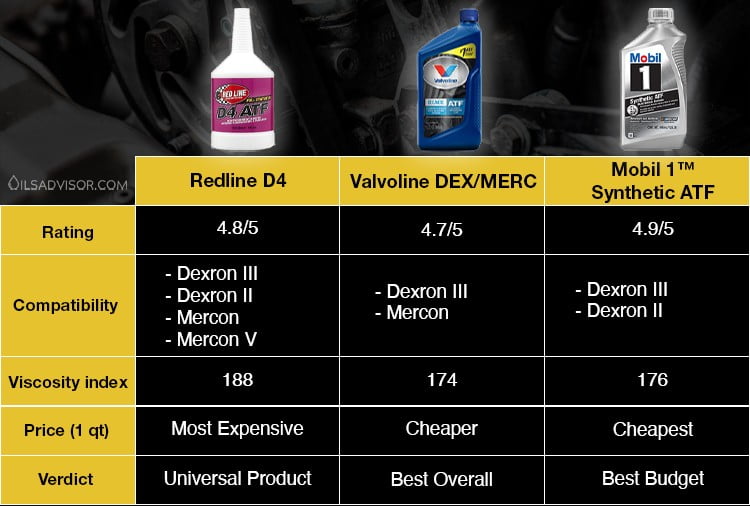
There are 3 alternatives to Type A transmission fluid: Redline D4, Valvoline DEX/Merc, and Mobil1 Synthetic ATF. Let’s see how they work in the real world.
Redline D4 ATF
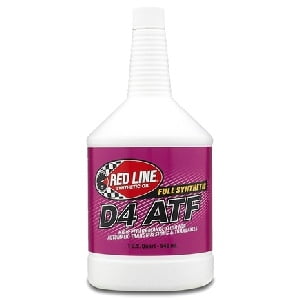
Red Line D4 ATF is designed with low-temperature properties compared to Dexron III fluid, and the improved shear-stability requirements of Mercon V.
- Provides lower viscosity at cold temps for quicker shifting
- Reduces volatility at high temperature
- Helps to extend drain intervals
- Prevents corrosion, oxidation, wear, and the formation of harmful deposits
- Has a strong smell after time
- High price
Red Line D4 ATF is a fully synthetic aftermarket equivalent for Type A automatic transmission fluid and serves as the most versatile option in Red Line’s ATF lineup. This fluid meets specifications for Dexron III, Dexron II, Mercon, and Mercon V applications. It is suitable for automatic transmissions, manual transmissions, power steering systems, and older vehicles that originally called for Type A.
The formulation uses a 0W-20 viscosity grade (equivalent to 70W-80 in gear oil terms) with a viscosity index of 188. This means the fluid maintains consistent performance across a wide temperature range. The pour point of -76°F ensures excellent cold-weather operation, which is critical for transmissions in northern climates where older fluids would struggle.
Red Line’s synthetic base provides improved thermal stability compared to conventional ATF. The fluid resists oxidation at high temperatures, which prevents varnishing on valves and clutches. This translates to extended drain intervals and better protection in transmissions that run hot or tow heavy loads.
For manual transmissions like the T-5, T-45, and T-56, D4 ATF delivers GL-4 level gear protection. Late-model BMW manual transmissions also benefit from this fluid. The synthetic formulation reduces friction without compromising the synchronizer engagement these transmissions need.
Compatible with these manufacturer specifications:
- Toyota: Type T-III, Toyota Type T-IV, T3, T4, ATF JWS 2312D, 3314, 3317, Mobil ATF 3309, JWS 3309
- Honda/Acura: ATF-Z1
- Nissan: Matic D, J, K
- Mitsubishi/Hyundai/Kia: Diamond SP-II, SP-III
- Mazda: ATF M-V (2003+ Mazda6, 2004+ Mazda3, 2006+ Mazda5, 2006+ Ford Fusion with FNR5)
- Subaru: ATF-HP, Castrol Transmatic J, Transmax J, Transmax E, Pennzoil ATF J, Idemitsu HP (2005+ WRX, Impreza, Legacy, Outback, Tribeca, 2006+ Forester)
- BMW: Esso LT71141 (1993+ 3/5/7 series with ZF 5HP), Shell LA2634 (1998-2000 3 series, 1994-1995 5 series, 1998-2000 528, 1994-2000 7/8 series), Texaco ETL7045 (2001 3 series Xi, X5 3.0, Z3, 1998-2005 3 series with GM5, 1999-2000 5 series with GM5, 2004-2008 X3 with GM5), Texaco ETL8072 B (2000-2005 5 series and X5 with GM5)
- Audi/VW: Esso LT71141 (1993+ automatics)
- Mercedes/Jeep/Porsche/Jaguar: Shell ATF 3403 M115 (Mercedes 5 & 6-speed, Jeep NAG-1, Porsche and Jaguar automatics)
- Volvo: Aisin-Warner applications (2001-2004 C70, 2001+ S40, V40, S60, S60R, 1999+ V70, V70R, XC70 with AW50AWD or AW55-50SN)
- Allison: TES 295, 389, 439, 468
- Idemitsu: K17 (Jatco 3100)
Valvoline DEX/MERC ATF
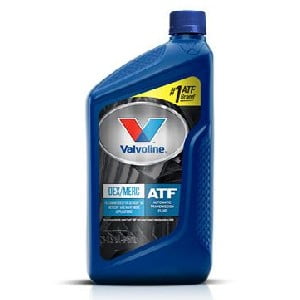
Valvoline DEX/MERC ATF is recommended for applications where Dexron, Dexron II, III is specified.
- Advanced anti-wear technology reduces foam and oxidation
- Ensures good oil flow in both low and high temperatures
- Enhanced anti-shudder protection helps maximize power transfer
- Provides smooth shifting
- The packaging is prone to damage
Valvoline ATF DEX/MERC is a mineral-based fluid formulated to meet the requirements of Dexron III and Mercon specifications. It is also an aftermarket equivalent for Type A automatic transmission fluid.
The mineral base oil formulation delivers a viscosity index of 176, which provides stable lubrication across a wide temperature range. At 100°C, the fluid maintains a viscosity of 7.2 mm²/s, while at 40°C it measures 35 mm²/s. The pour point of -42°C ensures reliable cold-weather operation. With a viscosity of less than 20,000 mPa.s at -40°C, the fluid flows properly even in extreme cold, preventing hard shifts and transmission damage during winter startups.
The additive package includes corrosion inhibitors, oxidation stabilizers, anti-foam agents, and deposit control additives. Special friction modifiers work with viscosity index improvers to create specific friction properties that enable smoother shifting. This is critical because automatic transmissions rely on precise friction characteristics at the clutch packs to engage gears properly.
The formulation resists thermal breakdown and maintains stable viscosity over extended service intervals. While Valvoline markets this primarily for modern transmissions, the Dexron III specification makes it suitable for older vehicles that originally called for Type A fluid.
Beyond automatic transmissions, this fluid works in certain manual transmissions, power steering systems, and hydraulic applications in earth-moving equipment and lifting machinery. Always verify compatibility with your specific application before use.
Compatible with these manufacturer specifications:
- GM: Dexron III G
- Ford: Mercon
- Allison: C-4
- Volvo: 97325, 97335, 97340
- ZF: TE-ML 05L, 09, 11A, 11B
Mobil 1 Synthetic ATF
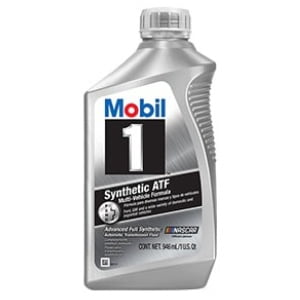
Mobil 1 Synthetic ATF is recommended for vehicles requiring Dexron III, Ford Mercon performance level.
- Helps improve fuel economy
- Keeps the tranny clean to have good performance
- Remains viscosity retention under severe operating conditions with high and low-temperature fluidity
- Provides excellent leakage control
- High price
Mobil 1 Synthetic ATF is a fully synthetic, multi-vehicle aftermarket equivalent for Type A automatic transmission fluid, designed to meet Dexron III, Mercon, and Mercon V specifications.
The synthetic formulation delivers a viscosity index of 176 with exceptional thermal stability. At 100°C, the fluid maintains 7.4 mm²/s viscosity, while at 40°C it measures 36.3 mm²/s. The pour point of -51°C and Brookfield viscosity of 10,040 mPa.s at -40°C ensure reliable cold-weather performance down to -54°C ambient temperature. This viscosity performs well in transmissions in extreme climates where conventional fluids would thicken and cause hard shifts or delayed engagement.
The synthetic base oil resists thermal breakdown at high operating temperatures. The film strength and anti-wear properties reduce component wear significantly. Friction modifiers maintain stable frictional characteristics over extended service intervals. This maintains consistent shift quality even under severe driving conditions.
Mobil 1 Synthetic ATF offers exceptional shear stability, meaning the viscosity stays consistent even under heavy-duty, high-temperature operation. The fluid is compatible with mineral-based ATFs and all common seal materials, so you can top off in emergencies without compatibility concerns.
Compatible with these manufacturer specifications:
- GM: Dexron, Dexron II, Dexron IID, Dexron IIE, Dexron IIiG, Dexron III, Dexron IIIH
- Ford: Mercon, Mercon V
- Allison: C-4
- Volvo: 97340
- JASO: 1-A (meets requirements)
Bonus: Chevy 5.3 Oil Capacity & Oil Type
Is Type A Transmission Fluid The Same as Dexron?
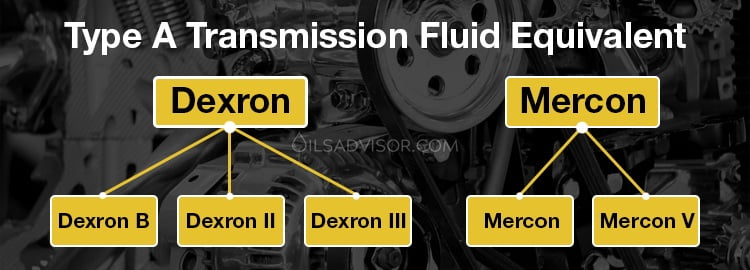
Type A and Dexron are not the same fluid. Dexron is the specification General Motors developed to replace the obsolete Type A standard. Think of it as the next generation in GM’s evolution of automatic transmission fluids.
Type A was GM’s original ATF specification dating back to the 1950s. It served vehicles like early Powerglides and Hydramatics for nearly two decades. Dexron emerged as GM’s approved replacement.
The original Dexron fluid offered better thermal stability and eliminated the whale oil dependency. Over the decades, GM has refined the specification through Dexron II, Dexron IID, Dexron IIE, Dexron III, and now Dexron VI.
GM’s official position states that Dexron VI is fully backward compatible with all earlier GM ATF specifications. Technical bulletins indicate it can be used in any application that originally called for Type A, Dexron, Dexron II, or Dexron III. Some owners have successfully run Dexron VI in 1954 Powerglides without issues.
However, contradictory advice exists. Some transmission specialists strongly advise against using Dexron VI, Dexron HP, or Dexron ULV in systems requiring Type A. They argue these newer formulations aren’t truly backward compatible despite GM’s claims. The concern centers on friction modifiers and additives that didn’t exist when older transmissions were designed.
The short answer for most GM transmissions that specified Type A: any ATF labeled as Dexron will function as an equivalent. Dexron was specifically designed to ensure service fill fluids meet appropriate quality standards for transmissions originally built around Type A performance characteristics. Whether you choose Dexron III or Dexron VI depends on your comfort level with newer formulations in vintage equipment.
Dexron B
The original Dexron (B) transmission fluid launched on April 1, 1967, as General Motors’ replacement for the obsolete Type A specification. Since then, GM has continuously upgraded Dexron through multiple iterations: Dexron-II (C), Dexron-II (D), Dexron-II (E), Dexron-III (F), Dexron-III (G), Dexron-III (H), Dexron-VI (J), Dexron HP, Dexron LV ATF HP, and Dexron ULV, which is the latest specification to date.
Each evolution brought improvements in thermal stability, oxidation resistance, and friction characteristics to meet the demands of advancing transmission technology. There’s one caveat though: The friction modifiers, detergents, and viscosity index improvers in newer formulations were engineered for transmissions designed decades after your Powerglide or Hydramatic left the factory.
Transmission shops working on vintage vehicles often stock Dexron III specifically because it bridges the gap between obsolete Type A requirements and modern fluid technology.
Dexron-II (C, D, E)
All Dexron-II variants (C, D, E) are backward compatible with earlier Dexron fluids and Type A specifications from 1949 to 1966.
Dexron-II emerged in 1973 as Dexron-II (C) when the U.S. Endangered Species Act banned sperm whale oil. The original Dexron (B) and earlier GM fluids had relied on sperm whale oil as a corrosion inhibitor. GM switched to a more stable hydrocracked Group 2 base oil with jojoba oil and other rust inhibitors, but this additive package corroded solder in some transmission coolers. This prompted the release of Dexron-II (D) in 1975 with alternative corrosion inhibitors.
Dexron-II (D) addressed the corrosion issue but introduced a new characteristic: the fluid became hygroscopic, meaning it absorbed moisture. While this wasn’t problematic in automatic transmissions, it made Dexron-II (D) unsuitable for other hydraulic systems where it was commonly used. This specification coincided with major transmission technology changes driven by 1975 CAFE regulations. The introduction of torque converter clutches in 1978 transmissions led to shudder complaints, prompting GM to revise Dexron-II (D) that same year.
Dexron-II (E) arrived in 1990 as electronic transmission controls replaced hydraulic systems. Cold-temperature fluid flow through solenoids became critical for shift quality, timing, and torque converter clutch operation. According to GM Technical Service Bulletin 92-7-2, Dexron-II (E) offered improved anti-foaming characteristics, better low-temperature flow (20,000 cP at -40°C versus 50,000 cP for earlier versions), and superior high-temperature oxidation stability. GM first used it in the 1991 Hydra-Matic 4L80-E, their first mass-produced electronically controlled transmission.
Dexron-III (F, G, H)
All Dexron-III variants are backward compatible with earlier Dexron fluids and Type A specifications from 1949 to 1966.
Dexron-III (F) arrived in 1993 with Group 2+ base oil and improved friction stability, higher oxidation resistance, and better material compatibility compared to Dexron-II (E). It maintained the same cold-temperature fluidity for reliable winter performance. However, this specification failed to address long-term durability issues like shear stability and fluid oxidation, leading to multiple revisions before GM eventually moved to entirely new thinking with Dexron-VI.
The evolution to Dexron-III (G) in 1998 came from solving a specific problem. Early OBD-II vehicles experienced false misfire codes because road forces transferred through the torque converter clutch affected crankshaft rotation sensors. GM developed the Variable Capacity Converter Clutch, which intentionally slipped around 35 rpm, but this created shudder and vibration issues. Dexron-III (G) was a synthetic blend specifically formulated to address VCCC shuddering while maintaining compatibility with power steering systems and hydraulic applications requiring excellent low-temperature flow.
Dexron-III (H) replaced (G) in 2003 with an updated friction modifier package and oxidatively stable Group 2 base oil. This delivered longer-lasting friction properties, better anti-shudder performance, improved foam control, and extended fluid life. The specification and licensing program ended in March 2011, though unlicensed products like ACDelco’s Type III (H) remain available for older transmissions.
Valvoline DEX/MERC ATF is recommended for applications where Dexron, Dexron II, III is specified.
Mobil 1 Synthetic ATF is recommended for vehicles requiring Dexron III, Ford Mercon.
Bonus: What Power Steering Fluid Is Compatible With 89021184?
Ford Mercon represents a series of technical standards for automatic transmission fluid developed and trademarked by Ford Motor Company. The Mercon name evolved into a licensed brand that Ford authorizes various manufacturers to produce according to its specifications. The original Mercon (M2C185-A) launched in January 1987, followed by Mercon V, Mercon SP, Mercon LV, and Mercon ULV. Like GM’s Dexron evolution, newer Mercon fluids are not always backward compatible with previous specifications.
Mobil 1 Synthetic ATF can meet Mercon performance level
Mercon V
Red Line D4 is a suitable replacement for Mercon V
Final Thought
While manufacturers advertise universal backward compatibility, blindly pouring modern Dexron VI into a 1950s transmission invites two specific risks often ignored in service bulletins.
First, modern Low Viscosity fluids rely on friction modifiers designed for the controlled slip of contemporary torque converter clutches. In a vintage Dynaflow or Hydramatic, these additives can prevent the rigid band engagement these units require, causing immediate friction material failure.
Second, consider seal chemistry. The aggressive detergent packages in modern synthetic fluids can dehydrate original rope and cork seals that relied on the fatty acids in whale oil to swell and maintain hydraulic pressure. For preservationists, “compatible” often refers to gear lubrication, not hydraulic seal retention.
If you find it hard to choose the best overall fluid among the products I discussed above, choose the Valvoline DEX/MERC ATF. I’m sure it won’t let you down!
Check Price at AmazonRelated Reads
- Toyota WS Transmission Fluid Alternative Discover alternatives to Toyota WS transmission fluid, providing insights into finding a suitable Type A transmission fluid equivalent – Learn more.
- Nissan CVT Fluid NS 2, NS 3 Equivalent Explore equivalents for Nissan CVT fluids NS 2 and NS 3 to identify suitable substitutes for Type A transmission fluid – Read more.
- Honda ATF DW-1 Equivalents: Best Alternatives and Substitutes Find the best alternatives to Honda ATF DW-1, which can help in selecting an equivalent for Type A transmission fluid – Find out more.
- Mopar ATF+4 Equivalent Learn about the best substitutes for Mopar ATF+4, providing insights into selecting a suitable Type A transmission fluid equivalent – Explore here.
- What Power Steering Fluid Is Compatible With MS5931 Understand compatibility with MS5931 to help identify suitable alternatives to Type A transmission fluid – Discover now.
![Motorcraft Coolant Equivalent: [Orange & Premium Gold]](https://oilsadvisor.com/wp-content/uploads/2021/07/motorcraft-coolant-1024x576.png)