
Nissan’s Continuously Variable Transmissions (CVTs) are sensitive to the fluid inside them. Using the wrong fluid, or skipping a service interval, is the leading cause of transmission failure. A replacement can run $4,000 or more.
One of the most common and costly myths about Nissan CVTs is that the fluid lasts the “lifetime” of the vehicle. Technical resources and experienced engineers recommend inspecting the fluid every 30,000 miles. At that interval, pull the fluid and check it for a burnt smell or dark contamination. Under normal driving conditions, plan to replace it every 60,000 miles. If you frequently tow, drive in mountainous terrain, or spend time on rough or muddy roads, that replacement interval drops to every 30,000 miles. Nissan’s transmission control module (TCM) tracks what is called a “deterioration count.” It is a number the computer calculates based on how hard and how hot the transmission has been working. If that count exceeds 210,000, the fluid must be changed immediately regardless of mileage.
Differences Between NS-2 and NS-3
Nissan redesigned its CVTs around 2013 and switched to a lower-viscosity fluid called NS-3 to improve fuel economy. The older fluid, NS-2, was used in models from roughly 2007 through 2012, including the Altima, Sentra, and Rogue. NS-3 covers 2013 and newer applications. Both fluids are green in color, though NS-2 can take on a greenish-brown tint over time. NS-3 runs at a lower viscosity, meaning it is thinner by design. These two fluids are not interchangeable. Some people claim NS-3 can serve as an “upgrade” in an NS-2 system. Official Nissan documentation does not support that. Using the wrong fluid causes belt slippage, overheating, and eventual transmission failure. If you discover the wrong fluid inside your CVT, often identifiable by a red color instead of green, you need to perform a double drain-and-fill to flush the system.
Aftermarket Alternatives to Nissan NS-3
The following fluids meet NS-3 specifications; NS-2 coverage is typically found in universal CVT fluids, as no manufacturer currently produces a dedicated NS-2 fluid.
Mannol CVT NS-3 (8220)
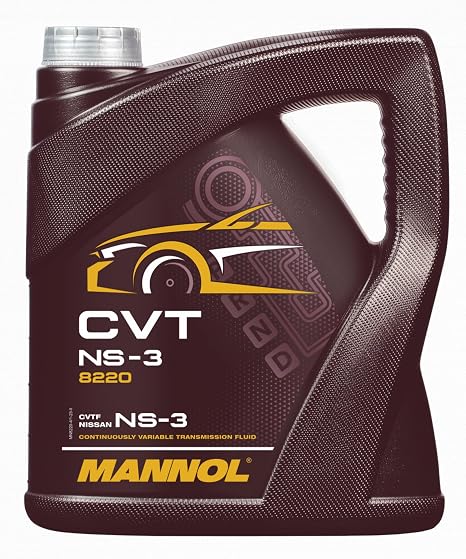
Mannol NS-3 Synthetic CVT Transmission Fluid
Mannol CVT NS-3 is an aftermarket-equivalent NS-3 fluid for Nissan CVTs, specifically engineered for JATCO CVT8 transmissions (JF016E/JF017E) found in the Altima, Pathfinder, Serena, and Teana.
Quick specs:
- Color: Green
- Base: Full synthetic
- Viscosity range: stable to -45°C
Mannol CVT NS-3 meets Nissan’s NS-3 specifications, and it can also replace Nissan Matic fluids where Matic W is required. The fluid stays stable from -45°C up through extreme heat. The additive package is built around friction stability, which directly addresses belt slippage and shudder. It also resists sludge and varnish buildup, two common causes of solenoid problems in aging CVTs. This is a practical choice for Nissan owners who want a tested NS-3 fluid at a lower price point than OEM. Also compatible with:
- Mitsubishi: DiaQueen CVTF-J4, CVTF-J1
- Toyota: CVT Fluid FE, CVT Fluid TC
- Subaru: Lineartronic CVTF II, CVT TR580/TR690, High Torque CVT
- Honda: HCF-2, HMMF (without starting clutch)
- BMW/Mini: EZL799, EZL799A, 83 22 0 136 376
Idemitsu CVTF Type N3

Idemitsu CVT Type N3 Transmission Fluid
Idemitsu CVTF Type N3 is an OEM-equivalent NS-3 fluid for Nissan and Infiniti CVTs, recommended for JATCO CVT7 and CVT8 transmissions.
Quick specs:
- Color: Green
- Base: Full synthetic
- Kinematic viscosity @ 40°C: 26.32 cSt
- Kinematic viscosity @ 100°C: 6.258 cSt
- Viscosity index: 202
Idemitsu is recognized as a factory-fill supplier for Nissan. This is likely the same fluid in the OEM bottle at a lower price. It meets NS-3 specifications and is formulated to match the exact friction materials used in JATCO CVT7 and CVT8 systems. The low-viscosity formula reduces CVT friction by up to 40%. Verified buyers consistently describe it as OEM fluid at a fraction of the dealership price. Owners of the 2015 Altima, 2016 Maxima, 2016 Pathfinder, and 2020 Rogue report smooth shifting and no CVT-related issues after switching to this fluid.
Aisin Synthetic ATF-NS3

Aisin NS-3 CVT Fluid for Nissan Infiniti
Aisin Synthetic ATF-NS3 is an OEM-formulated NS-3 fluid for Nissan and Infiniti CVTs, and a direct replacement for Nissan part numbers 999MP-NS300P and 999MP-CV0NS3.
Quick specs:
- Color: Clear blue
- Base: Full synthetic
- Kinematic viscosity @ 40°C: 29.6 mm²/s
- Kinematic viscosity @ 100°C: 6.46 mm²/s
- Viscosity index: 181
- Pour point: -45°C
- Flash point: 202°C
Aisin is one of the world’s largest transmission manufacturers, supplying major automakers including Toyota. That background carries weight when it comes to fluid formulation. This fluid is built to match the friction materials and pressure settings of JATCO CVT units. It specifically targets judder, a common complaint in higher-mileage Nissan CVTs. This is a solid choice for Nissan and Infiniti owners looking for an OEM-caliber NS-3 fluid. Do not mix with NS-2. Owners report the fluid looks, feels, and smells identical to the OEM fluid. One Altima owner at 171,000 miles eliminated judder and rough acceleration after a flush. That said, reviewers note it is not a fix for a transmission already showing signs of internal damage.
Valvoline CVT Full Synthetic

Valvoline CVT Full Synthetic Transmission Fluid
Valvoline CVT Full Synthetic is a compatible NS-1, NS-2, and NS-3 fluid for Nissan and Infiniti CVTs, covering belt and chain-driven units across multiple model years.
Quick specs:
- Color: Clear
- Base: Full synthetic
- Kinematic viscosity @ 40°C: 33.9 mm²/s
- Density @ 25°C: 0.8436 g/cm³
- Flash point: >104°C
Valvoline is a broad-coverage CVT fluid, which is its main advantage. It meets NS-1, NS-2, and NS-3 specs. The shear-stable viscosity modifiers help it hold up under heat and load better than conventional fluids, and the anti-shudder additives target the belt slippage and jerky acceleration that show up as CVTs age. This is a practical option for owners who want a single, reliable fluid at a price below OEM, particularly for routine maintenance on out-of-warranty vehicles. Owners consistently report smoother acceleration and reduced judder after switching to Valvoline. A 2017 Sentra owner reached 127,000 miles without a single CVT issue using this fluid exclusively. Some mechanics suggest pairing it with a filter and strainer change to get the most out of the service.
Also compatible with:
- Honda: HCF-2, HMMF (without starting clutch)
- Mitsubishi: DiaQueen CVTF-J1, CVTF-J4
- Toyota: CVT Fluid FE, TC
Castrol Transmax ATF/CVT Universal

Castrol Transmax ATF/CVT Transmission Fluid
Castrol Transmax ATF/CVT Universal is a compatible NS-1, NS-2, and NS-3 fluid for Nissan and Infiniti CVTs, and one of the few fluids on the market that also works in traditional stepped automatic transmissions.
Quick specs:
- Color: Red
- Base: Full synthetic
- Kinematic viscosity @ 40°C: 34.2 mm²/s
- Kinematic viscosity @ 100°C: 7.1 mm²/s
- Viscosity index: 179
- Pour point: -51°C
- Flash point: 214°C
Castrol’s main selling point here is versatility. It covers both CVT and traditional automatic transmissions, which is useful for shops or owners servicing multiple vehicles. It meets NS-1, NS-2, and NS-3 specs and holds up well under heat and heavy use. That said, the “universal” label makes some transmission specialists uncomfortable. A Subaru master technician in user feedback specifically warned that a single belt slip event can permanently damage a CVT drum, and advised sticking to OEM fluid. That concern is worth taking seriously on vehicles still under warranty. This fluid suits out-of-warranty owners servicing multiple vehicles, or shops wanting one fluid for both CVT and automatic transmission services.
Also compatible with:
- Toyota/Lexus: CVT Fluid FE, CVT Fluid TC
- Honda: HCF-2 (except 2001–2007 Fit/Jazz with starting clutch)
- Subaru: Lineartronic High Torque Chain CVTF, i-CVT, i-CVT FG
- Mitsubishi: DiaQueen CVTF-J1, CVTF-J4, CVTF-J4+
- Audi/VW: TL 521 16 (G 052 516), TL 521 80 (G 052 180), Multitronic
Motul Multi CVTF

Motul Multi CVTF Synthetic CVT Fluid
Motul Multi CVTF is a compatible NS-1, NS-2, and NS-3 fluid for Nissan and Infiniti CVTs, engineered for both chain/pulley and belt/pulley CVT systems. Quick specs:
- Color: Blue
- Base: Synthetic (Technosynthese®)
- Kinematic viscosity @ 40°C: 34.3 mm²/s
- Kinematic viscosity @ 100°C: 7.2 mm²/s
- Viscosity index: 180
- Flash point: 210°C
Motul Multi CVTF covers NS-1, NS-2, and NS-3 specifications in a single fluid. The anti-shudder additive package targets belt and pulley wear directly, and the formula maintains shear stability under high heat, which helps extend fluid life between changes. One hard limit: this fluid is not recommended for CVT units in hybrid vehicles. This suits out-of-warranty Nissan owners who want a premium fluid with broad compatibility, particularly those servicing multiple vehicles across different makes. Verified buyers rate it 5.0 out of 5 stars. Vehicle owners praise it for smooth, responsive shifting. Users consistently describe it as a better value than bulk OEM fluid purchases.
Also compatible with:
- Subaru: Lineartronic CVTF, High Torque CVT, CVT II, TR580, TR690
- Toyota/Lexus: CVT FE, TC
- Honda: HCF-2, HMMF, Z-1 (without starting clutch)
- Mitsubishi: DiaQueen CVTF-J1, CVTF-J4, CVTF-J4+
- Audi/VW: TL 521 16, TL 521 80, G 052 180, G 052 516
Closing Notes
When a Nissan CVT overheats, it enters fail-safe mode, also known as limp mode. Engine power is cut and the transmission limits itself to prevent further damage. If your dashboard lights up, start by diagnosing the transmission temperature warning before assuming the worst. CVT fluid does not have its own dedicated cooler in most Nissan applications. It runs through a heat exchanger connected to the engine’s radiator. If your engine coolant mixture exceeds 60% ethylene glycol, the coolant loses efficiency and the transmission runs hotter. A standard 50/50 water-to-glycol mix is correct. A clogged or obstructed air filter forces the engine to work harder, which generates excess heat that transfers to the CVT fluid. Check and replace the air filter on schedule. A high-pitched whine during acceleration is often the first sign that the fluid has broken down. Do not wait if you hear it. Changing the fluid early may save the transmission. If the whine continues after a fresh fluid change, internal damage has likely already begun and a deeper inspection is needed.
![Motorcraft Coolant Equivalent: [Orange & Premium Gold]](https://oilsadvisor.com/wp-content/uploads/2021/07/motorcraft-coolant-1024x576.png)

“And as Valvoline claims, the product doesn’t void any new vehicle’s warranty. This is a big plus for Valvoline, but I actually don’t know how they can do that.”
Easy answer. The Magnuson-Moss Warranty Act of 1975. The manufacturers are prohibited from requiring specific brands of parts or fluids unless they provide those items free of charge to the consumer. They may require that fluids and parts meet specifications, and any aftermarket manufacturer is free to provide products that meet those specifications, and any consumer is free to use products that meet those specifications, without fear of voiding the OEM warranty. The key is for the aftermarket product to meet OEM specifications. If it doesn’t meet those specifications, then use of it may indeed void the warranty.
thanks for the info.
Many thanks!