
ILSAC GF-6A is a performance standard for passenger car gasoline engine oils, introduced in May 2020. It is a set of requirements an oil must meet before it can carry the API Starburst certification mark on the container.
The standard covers the traditional low-viscosity multigrades: 0W-20, 5W-20, 0W-30, 5W-30, and 10W-30. This is what separates it from GF-6B, which exists solely for 0W-16. Because GF-6A covers these common grades, it’s fully backward compatible with any engine that previously required GF-5 or older.
GF-6A was developed in response to turbocharged gasoline direct-injection (TGDI) engines. These engines are prone to Low-Speed Pre-Ignition (LSPI), an abnormal combustion event where the air-fuel mixture ignites before the spark plug fires. The pressure spike can bend connecting rods or crack pistons. GF-6A was the first standard to address LSPI directly.
This standard also tightened requirements for timing chain wear, piston and turbocharger deposit control, sludge resistance, and fuel economy retention.
For owners of newer turbocharged engines, GF-6A compliance is required as these engines were designed around it. For owners of older vehicles, a GF-6A oil of the correct viscosity is a safe, direct replacement for whatever older category the manual specifies.
Recommended ILSAC GF-6A Oils
Below is a list of the top-rated ILSAC GF-6A engine oils that will help you narrow down your search.
Idemitsu IFG3 0W-20 SP/GF-6A

Idemitsu IFG3 0W-20 SP/GF-6A Full Synthetic Motor Oil
Idemitsu IFG3 0W-20 SP/GF-6A is a fully synthetic GF-6A-compliant aftermarket equivalent for any gasoline engine requiring SAE 0W-20. It’s a straightforward pick for owners of turbocharged, hybrid, or stop-start vehicles who want a certified alternative to dealer-branded oil.
This product is frequently cited among the best 0W-20 motor oil brands for its consistent performance in cold-start scenarios.
Specifications
- Viscosity: 0W-20
- Type: Fully synthetic
- Certification: API SP / ILSAC GF-6A
- Viscosity Index: 168
- Pour Point: -45°C
- Flash Point: 216°C
- Noack Volatility: 12.5 wt% (limit: 13.0)
- TBN: 7.15 mgKOH/g
- Sulfated Ash: 0.72 wt%
The viscosity index of 168 is worth noting. Most conventional 0W-20 oils sit in the 150–160 range. A higher index means the oil holds its viscosity more consistently across temperature swings.
This product is for owners of modern gasoline-powered vehicles (turbocharged, hybrid, or stop-start) whose manual specifies 0W-20 and API SP or GF-6A.
Motul Asian Import 5W-20
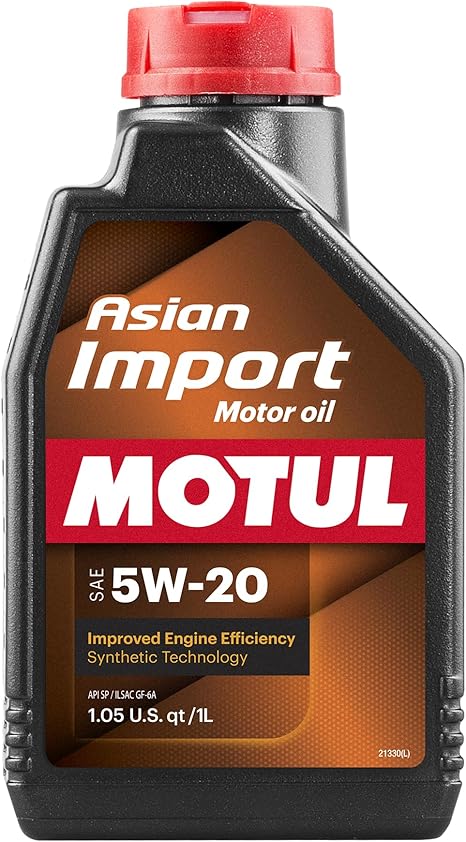
Motul Asian Import 5W20 Synthetic Oil
Motul Asian Import 5W-20 is a synthetic GF-6A-compliant aftermarket equivalent for gasoline and hybrid gasoline engines requiring SAE 5W-20. It’s built specifically for Asian import vehicles, naturally aspirated or turbocharged, where the manual calls for a fuel economy-rated 5W-20.
When deciding between this and a heavier oil, it helps to understand the difference between 5W-20 and 5W-30 regarding film strength and fuel efficiency.
Specifications
- Viscosity: 5W-20
- Type: Technosynthese® (synthetic)
- Certification: API SP / ILSAC GF-6A
- Viscosity Index: 142
- HTHS: 2.7 mPa·s
- Pour Point: -47°C
- Flash Point: 229°C
- TBN: 7.1 mgKOH/g
- Sulfated Ash: 0.73 wt%
Motul Asian Import 5W-20 holds enough film strength for turbocharged engines without sacrificing the low-friction properties the standard requires.
The flash point of 229°C is on the higher end for this viscosity class, which means better resistance to oil burn-off under sustained heat. It can be mixed with synthetic or mineral oils if you’re topping off rather than doing a full change.
This product is for owners of Asian import vehicles Toyota, Honda, Nissan, Hyundai whose manual specifies 5W-20 with API SP or GF-6A compliance.
Ultra1Plus SAE 0W-20 Full Synthetic Motor Oil (UL101)

ULTRA 1PLUS SAE 0W-20 Full Synthetic Oil
A fully synthetic GF-6A-compliant aftermarket equivalent for gasoline engines requiring SAE 0W-20, including turbocharged and supercharged applications. It’s a straightforward pick for owners who want a certified alternative that also satisfies GM dexos1 Gen 2 and major OEM specs.
Specifications
- Viscosity: 0W-20
- Type: Full synthetic
- Certification: API SP / ILSAC GF-6A
- Viscosity Index: 165
- Pour Point: -47°C
- Flash Point: 210°C
- Viscosity @ 40°C: 44.55 cSt
- Viscosity @ 100°C: 8.3 cSt
The viscosity index of 165 indicates good thermal stability across a wide temperature range. The pour point of -47°C and cold cranking viscosity of 5,400 cP at -35°C both sit well within GF-6A cold-start requirements.
Ultra1Plus SAE 0W-20 Full Synthetic is for owners of modern gasoline-powered vehicles whose manual calls for 0W-20 with API SP or GF-6A compliance.
Liqui Moly Molygen New Generation 5W-30

Liqui Moly 20226 Molygen New Generation 5W-30
Liqui Moly Molygen New Generation 5W-30 is a fully synthetic GF-7A-compliant (backwards compatible with GF-6A) aftermarket equivalent for modern gasoline engines requiring SAE 5W-30.
In the ongoing debate of Liqui Moly vs. Mobil 1, the Molygen series stands out for its specialty additives.
Specifications
- Viscosity: 5W-30
- Type: Full synthetic
- Certification: API SQ / ILSAC GF-7A
- Viscosity Index: 162
- HTHS: ≥2.9 mPa·s
- Pour Point: -42°C
- Flash Point: 230°C
- Noack: 9.8 wt%
- TBN: 7.2 mgKOH/g
- Sulfated Ash: <0.8 g/100g
Its standout feature is a molybdenum-based friction modifier that bonds to metal surfaces and reduces wear independently of the base oil film. It’s most relevant in stop-start driving and cold starts.
Liqui Moly Molygen New Generation 5W-30 is for owners of modern Asian or American gasoline engines whose manual calls for 5W-30 with API SP or GF-6A compliance.
Also compatible with these OEM standards:
- Ford WSS-M2C 946-A, 946-B1, and 961-A1
- Chrysler MS-6395 and Fiat 9.55535-CR1
Castrol EDGE Extended Performance 5W-30

Castrol Edge Extended Performance 5W-30
Castrol EDGE Extended Performance 5W-30 is a fully synthetic GF-7-compliant product aimed at owners who want to stretch their oil change intervals.
Specifications
- Viscosity: 5W-30
- Type: Full synthetic
- Certification: API SQ / ILSAC GF-7 / ACEA A5/B5, C2
- Viscosity Index: 163
- Pour Point: -42°C
- Flash Point: 231°C
- Viscosity @ 40°C: 60 mm²/s
- Viscosity @ 100°C: 9.9 mm²/s
- CCS @ -30°C: 4,480 mPa·s
- Sulfated Ash: 0.77 wt%
The ACEA C2 rating means the oil meets low-SAPS requirements for diesel particulate filter compatibility, making it one of the few 5W-30s that crosses over cleanly between North American and European specs.
Castrol EDGE Extended Performance 5W-30 is for owners of gasoline or light diesel vehicles whose manual calls for 5W-30 with API SQ, GF-7, or ACEA A5/B5 compliance, and who want to run extended drain intervals without stepping outside a certified spec.
Also compatible with these OEM specs:
- GM dexos1 Gen 3 (approval: D355AQDC082)
- Honda HTO-06
- Chrysler MS-6395
- Ford WSS-M2C946-A, WSS-M2C946-B1, and WSS-M2C961-A1
How to Buy the Right GF-6A Oil
If you are feeling overwhelmed by the different labels and technical specs, this simple guide will help you verify that you’re selecting an oil that is both GF-6A compliant and the correct fit for your specific vehicle.
Step 1: Check your owner’s manual. It specifies the viscosity grade and performance category your engine requires. If it calls for GF-5 or older, GF-6A is a safe replacement.
Step 2: Confirm the viscosity grade. GF-6A covers SAE 0W-20, 5W-20, 0W-30, 5W-30, and 10W-30. If your car requires 0W-16, you need GF-6B instead. GF-6B uses a different API “Shield” mark and is not backward compatible with older engines.
Step 3: Check the certification marks. Look for the API Starburst on the front of the container. On the back, the Donut should read “API SERVICE SP” on top and “RESOURCE CONSERVING” on the bottom.
Step 4: Check for manufacturer-specific approvals. Some brands go beyond ILSAC. GM requires dexos1 Gen 3 on many newer models. European brands like BMW, VW, and Mercedes typically specify ACEA sequences or proprietary Long Life standards.
A Note on “ILSAC GF-6” Without a Letter
Some marketing materials and product descriptions use “GF-6” as a general term for this generation of oil technology. If a bottle says GF-6 without specifying A or B, you can identify which subcategory it belongs to in two ways.
Check the viscosity grade first. If it’s 0W-20, 5W-20, 0W-30, 5W-30, or 10W-30, it’s a GF-6A product and is backward compatible with older engines. If it’s 0W-16, it’s GF-6B — an ultra-low viscosity grade designed for newer engines that specifically require it.
Then check the certification mark. The API Starburst indicates GF-6A. The API Shield indicates GF-6B.
Both subcategories provide the same LSPI and timing chain wear protection. The split exists because 0W-16 oils deliver better fuel economy but can only be used in engines engineered for that viscosity. If your manual simply says “GF-6,” a GF-6A oil of the correct viscosity covers you.
Closing Notes
Modern engines are engineered around oils. Tight bearing clearances, turbochargers spinning past 200,000 RPM, and low-tension piston rings all assume a specific oil behavior profile. GF-6A exists because the margin for error in these engines is narrower than it’s ever been.
Using the correct standard is about maintaining the operating conditions the engine was designed around. The right oil preserves fuel economy, emissions performance, and mechanical longevity at the same time.
In practical terms, an oil that meets GF-6A keeps the engine performing the way it did when it was new.