Fresh ATF is translucent and bright red. Manufacturers dye it specifically so you can distinguish it from other fluids under the hood and spot leaks on your driveway.
The easiest way to check your fluid is to pull the transmission dipstick and wipe it on a white paper towel.
Brand new fluid is a clean, translucent red. As it ages normally, it darkens to a brick red. That’s fine. Once it shifts to a deep rust red, you’re approaching service territory. Brown or black fluid means the transmission needs attention now. That color indicates the fluid is severely degraded, the filter may be compromised, or something more serious is happening internally.
A quick note on variations: manual transmission fluid is thicker and typically runs brown to amber. Some specialized ATFs, including certain fluids for RAM models, are clear or green.
Color isn’t the only indicator. A burnt smell is a direct sign the fluid is overheating and no longer protecting internal components. Whining, humming, clunking, or grinding while driving or shifting points to inadequate lubrication.
Difficulty shifting, gear slippage, or erratic behavior between gears are all symptoms of fluid that’s no longer doing its job. A 2 to 3 second delay when shifting from Park into Drive or Reverse is another common sign. So is the vehicle surging forward unexpectedly or feeling sluggish from a stop.
If you find red puddles under the middle of the vehicle, that’s a leak. Find the source before the fluid level drops low enough to cause damage.
Fluid Change vs. Flush
A drain and fill works exactly as it sounds. A technician removes the drain plug or drops the transmission pan and lets gravity do the work. The catch is that only one-third to one-half of the total fluid volume actually drains out. The rest stays trapped in the torque converter and cooler lines.
For high-mileage vehicles or transmissions that haven’t seen regular service, this is usually the right call. It replaces a meaningful amount of fluid without disturbing any deposits that may have settled inside.
A flush uses a machine connected to the transmission cooler lines. With the engine running, it forces new fluid through the entire system, pushing all the old fluid out. The result is a complete fluid replacement. For a newer vehicle with a consistent service history, this is effective.
For a high-mileage or neglected transmission, many mechanics advise against it. The pressure involved can dislodge debris and worn clutch material that may actually be helping marginal components maintain grip. Disturbing that can trigger slipping or, in some cases, accelerate failure.
As a general rule, follow your manufacturer’s maintenance schedule. Most specify a transmission service every 30,000 to 60,000 miles. If your vehicle has significant mileage and no service history, a simple drain and fill is the lower-risk starting point.
When to Change Your Transmission Fluid
Recommendations vary by transmission type and driving conditions, but these ranges give you a working baseline.
Automatic transmissions generally call for a fluid change every 30,000 to 60,000 miles. Manual transmissions typically fall in the 50,000 to 60,000 mile range. CVTs are a different case. Their unique belt-and-pulley design puts more stress on the fluid, and many technicians recommend changing it closer to every 30,000 miles.
If your driving involves frequent towing, off-roading, or operating in extreme heat, cold, or humidity, shorten your interval. A good rule of thumb is to cut it in half under those conditions.
Some manufacturers label their transmission fluid as a lifetime fill, meaning no scheduled change is listed. This claim deserves some skepticism. Many technicians recommend changing it between 50,000 and 100,000 miles regardless, particularly once the factory warranty has expired. The fluid degrades over time whether the label says so or not.
How Manufacturer Recommendations Actually Vary
The range across makes and models is wide. A 2021 Ford F-150 may list 150,000 miles as the exchange interval under normal use.
A 2023 Nissan Altima specifies service every 60,000 miles. Honda, in some cases, simply instructs the dealership to check the fluid and replace it if necessary, without committing to a fixed interval.
When there’s no set schedule, use condition as your guide. Dark discoloration, a burnt smell, or any shifting irregularities are enough reason to have a technician inspect the fluid.
Brown or black fluid means the situation is serious. At that stage, the fluid has likely oxidized from heat exposure and lost its ability to lubricate and cool transmission components effectively. If a burnt smell accompanies that dark color, there may already be internal damage or a failed filter involved.
Beyond color, certain contaminants in the fluid indicate specific problems worth knowing.
Metallic flakes or a glittery appearance in the fluid means an internal component is grinding down. That requires immediate attention. Fluid that looks like a pink milkshake, cloudy and light, points to water or coolant contamination. This is a critical issue.
Coolant in the transmission accelerates component wear and can lead to total failure if not addressed quickly. Foamy or bubbly fluid on the dipstick suggests the system is either overfilled or has an internal air leak, both of which affect shift quality.
Popular Automatic Transmission Fluids
Below are some of the best-selling transmission fluids out there. You can’t go wrong with these brands. But you could with the specs. So be sure to check your owner’s manual for compatibility.
Castrol Transmax ATF/CVT Universal

Castrol Transmax ATF/CVT Universal Automatic Transmission Fluid
Castrol Transmax ATF/CVT Universal is a high-performance, full-synthetic fluid engineered for use in a wide array of automatic transmissions, including both traditional stepped automatics and Continuously Variable Transmissions (CVT). The fluid is typically red in color.
This “one-stop” solution eliminates the risk of using the wrong fluid in mixed-technology fleets, providing balanced frictional characteristics for smooth shifting and consistent power delivery.
If you have ever struggled with identifying whether your vehicle requires a specific ATF or a CVT fluid, this product solves that dilemma by meeting the requirements of both.
This is ideal for owners of multi-vehicle households or shops that need a reliable, high-specification fluid that covers the majority of passenger car applications without compromising performance.
Compatible with:
- Toyota: T-III, T-IV, WS
- Honda/Acura: ATF Z-1, DW-1, HCF-2
- Nissan: Matic D, J, K, S, W, NS-1, NS-2, NS-3
- Subaru: ATF, ATF-HP, CVTF 3353, Lineartronic CVTF
Motorcraft MERCON LV
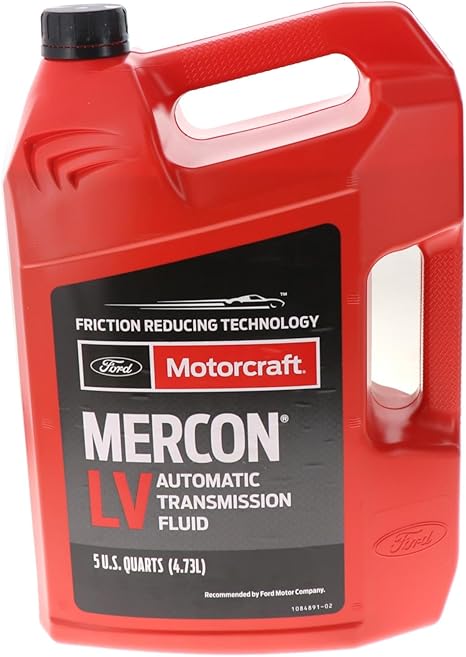
Motorcraft – Mercon Transmission Fluid
Motorcraft MERCON LV is a premium-quality automatic transmission fluid specifically designed for Ford, Lincoln, and Mercury vehicles requiring the MERCON LV specification. The fluid is dyed red for easy leak detection.
If you have ever struggled with erratic shifting or increased vibration in modern Ford transmissions, this fluid provides the precise frictional properties needed to maintain smooth operation.
Its standout feature is its high viscosity index and shear stability. This ensures the fluid stays within grade for the duration of the service interval without thinning out under heavy loads.
Motorcraft MERCON LV is ideal for Ford owners who want to maintain their factory warranty and ensure long-term protection against rust, corrosion, and wear in high-thermal environments.
Compatible with:
- Ford: MERCON LV (License no. MLV070701)
- WSS-M2C938-A: Recommended for use where this specification is required
ACDelco DEXRON-VI Full Synthetic ATF

ACDelco GM Original Equipment Dexron VI ATF
ACDelco DEXRON-VI is a fully synthetic automatic transmission fluid formulated to be the factory-fill and service-fill lubricant for General Motors vehicles. The fluid is also red in color. It offers twice the service life of previous DEXRON generations.
If you’ve ever struggled with the early breakdown of transmission fluid in older GM vehicles, this fluid solves that problem by offering significantly improved oxidation and friction durability.
This is the perfect match for GM owners seeking a high-performance upgrade that extends drain intervals and improves fuel economy in modern 6-speed transmissions.
Compatibilities:
- General Motors: GMW16444
- Backward Compatible: All DEXRON applications prior to DEXRON-VI
Valvoline ATF+4

Valvoline ATF 4 Full Synthetic Automatic Transmission Fluid
Valvoline ATF+4 is a full-synthetic automatic transmission fluid uniquely engineered to meet the specific requirements of FCA (Chrysler, Dodge, Jeep, and Ram) vehicles. The fluid is red in color.
If you have ever struggled with “transmission hunt” or shudder in a Jeep or Dodge, this fluid’s specific friction modifiers are designed to eliminate those issues. Its standout feature is its exceptional low-temperature fluidity.
Valvoline ATF+4 is ideal for Mopar transmissions that need a fluid that is fully compatible with ATF+3, ATF+2, and ATF+ types while providing superior wear protection.
Compatible with:
- FCA: MS-9602 (License no. 40630041)
- Mopar: 05013457AA, 05013458AA, 05103526EA, 05103531EA
Idemitsu ATF Type-H Plus

Idemitsu ATF Type H-Plus Automatic Transmission Fluid for Honda
ATF Type-H Plus is a synthetic automatic transmission fluid specially developed for Honda and Acura vehicles equipped with modern multi-speed transmissions. This fluid is red in color. It is designed to offer maximum protection and smooth shifting throughout the fluid’s life.
you have ever struggled with the high cost of Honda Genuine DW-1 fluid, this product provides a high-quality alternative that meets the same rigorous standards.
Its standout feature is its excellent anti-foaming properties, which ensure consistent hydraulic pressure in high-revving Honda drivetrains.
This is ideal for Honda and Acura enthusiasts who demand a fluid that maintains its viscosity and friction characteristics under demanding city driving conditions.
Some car owners claim that Idemitsu is the OEM company for Honda’s transmission fluids:

Genuine Honda Fluid 08798-9031 Manual Transmission Fluid
A Few Things Worth Knowing
Color alone has limits as a diagnostic tool. Ford’s Mercon LV, for example, is known to darken quickly due to its dye formulation. If you’re running that fluid, don’t rely on color as your primary indicator. Track mileage and pay more attention to smell and shift behavior instead.
Manual transmission fluid is naturally thicker and runs brown to amber. Don’t confuse that with degraded ATF.
Check your fluid once a month using the dipstick and a white paper towel. The paper towel gives you an accurate read on both color and transparency. Once the color moves past brick red toward rust red, schedule service. Don’t wait for it to go brown.
Final Thoughts
Most transmission failures don’t happen suddenly. They develop over thousands of miles of ignored signals, small friction increases, gradual heat buildup, and fluid that stopped protecting long before it turned black. The checks described here cost nothing and take two minutes. What they give you is a window into a system that otherwise operates completely out of sight.
The drivers who get 200,000 miles out of a transmission aren’t doing anything complicated. They’re checking fluid regularly, catching problems early, and following a service schedule. That’s the whole strategy.
Your transmission doesn’t have a warning light for degraded fluid. The dipstick is it. Use it before the repair bill teaches you why you should have