
Power steering fluid (PSF) leaks show themselves in three main ways:
- distinctive red or brown drips underneath the front of your vehicle
- changes in how your steering feels
- unusual noises coming from under the hood.
The leaks themselves typically stem from worn-out components in the hydraulic system, which is constantly working under serious pressure every time you turn the wheel.
Read on to understand more about these reasons that lead to this problem, how to fix them, and the cost of fixing them.
Let’s dive in!
Causes and Solution of Power Steering Fluid Coming Out Of Reservoir Cap
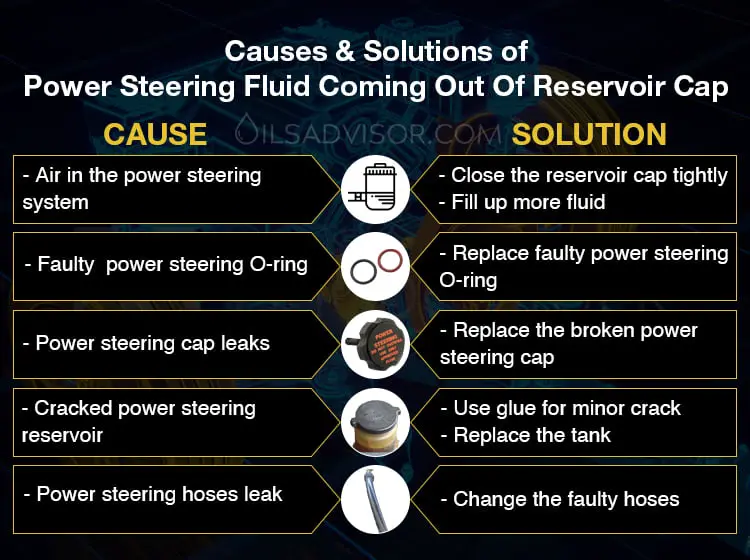
Air In The Power Steering System
Air enters the power steering system primarily through leaks or restrictions on the suction (low-pressure) side of the pump. Here’s where to look:
A bad O-ring on the suction side of the pump is a very common cause, especially in certain vehicle models. This failure allows the pump to suck in air when the engine is running, which causes the reservoir fluid to foam up and spew power steering fluid out from the cap.
Low fluid levels from a leak elsewhere can cause the power steering pump to run dry or intermittently ingest air, leading to foaming and expulsion.
A blocked orifice or a restricted return flow can cause pressure buildup in the reservoir, leading to fluid being forced out of the cap. A clogged or torn filter built into the reservoir can also restrict fluid flow. This restriction causes a high fluid flow rate and pump noise from the extra air being introduced into the system.
How to Remove Air from the Power Steering System
If you run the car with the cap off and turn the wheel, and the fluid in the reservoir is bubbling, this indicates that air is continuously entering the system.
Removing air from the power steering system, commonly called “bleeding” or “burping” the system, clears trapped air bubbles that can cause whining, groaning, and even force fluid out of the reservoir cap.
The basic method involves slowly cycling the steering wheel to push air out of the hydraulic lines and up into the reservoir, where it can escape. Some power steering systems also have a bleed screw that provides a more direct way to purge air from the pump.
Standard Bleeding Method (No Bleed Screw)
1. Start by checking your fluid level and topping it up with the manufacturer-specified fluid. Keep the fluid level high to prevent more air from being drawn in.
2. You may place the front of the car on jack stands so the front wheels are off the ground. This helps burp the rack and lines.
3. With the cap off and the engine turned off, slowly turn the steering wheel from lock-to-lock (all the way left, then all the way right) multiple times. You may need a spotter to ensure the fluid doesn’t overflow while doing this.
4. Next, start the motor and turn the steering wheel all the way left and right. There are two ways you can do this bit. You can cycle the rack fast to prevent the pump from tearing the air into smaller bubbles, making them harder to remove. Another way to do it is to cycle the rack limit-to-limit one time each way, then let it sit.
5. Allow the system to sit for a period (15 minutes or half an hour) with the motor off to let air bubbles escape.
Power steering systems are not always easy to burp. However, if you have to repeat the process more than three times, you likely haven’t done it correctly and should check for an underlying issue.
Bleeding Method (With Bleed Screw)
If your power steering pump has a bleed screw, typically found on the back of the pump near the top, you can use this more direct method:
1. Park your car on a level surface and turn off the engine. Use a jack to raise the front end of your car and support it with jack stands.
2. Locate the power steering bleed screw on the back of the power steering pump near the top. Position a catch basin or small bucket under the bleed screw.
3. Carefully loosen the bleed screw with a wrench, avoiding damage to the threads.
4. Start the engine and let it idle for a few minutes. Monitor the power steering fluid level in the reservoir while the engine is running, adding more fluid if needed.
5. Once the fluid coming out of the bleed screw is free of air bubbles, tighten the bleed screw. Lower the car from the jack stands and take it for a test drive.
Addressing the Root Causes
If air is continually reintroduced, bleeding alone isn’t the full solution. A common cause of air ingestion is a bad O-ring on the suction side of the pump. Replacing this inexpensive part (sometimes a dollar part) is an easy DIY fix that stops the reservoir from foaming up and spewing fluid.
If the issue is due to a clogged or torn filter built into the reservoir causing restricted flow and air introduction, the reservoir should be replaced. You can use brake cleaner and compressed air to attempt to clean the reservoir filter before reinstalling.
Check the low-pressure pipes and reservoir and try tightening connections if they’re loose.
If the problem returns after flushing and bleeding (for example, the noise and fluid expulsion come back after driving 100 kilometers), this indicates that a restriction or a leak, such as a tear in the reservoir filter or a bad hose, is continually introducing air. That component needs to be replaced.
Related Post: What Power Steering Fluid Is Compatible With MS5931
How to Fix Faulty Power Steering O-rings
Another possible reason why your vehicle’s power steering fluid is leaking is due to faulty O-rings. The function of O-rings is simple; to block water or any liquid from escaping. There are many places where O-rings are used in a vehicle, and the power steering system is inclusive.
Worn or cracked seals and O-rings are the most common cause of PSF leaks. Seals surrounding the power steering pump deteriorate over time. They lose flexibility, dry out, and crack, leading to degradation and corrosion. A specific cause for leaks and fluid foaming is a bad O-ring on the suction side of the pump, which allows air into the system. The pinion seal or the rack pinion seal can also harden and leak.
How To Fix Faulty O-Rings
If you observe steering fluid spraying droplets or seepage from the vent hole in the cap, it may be due to the rubber O-ring that seals the cap to the reservoir hardening from engine bay heat.
If the pump is sucking air, causing the fluid in the reservoir to foam up and spew fluid out, the issue is often a bad O-ring on the suction side of the pump.
Leaks are also commonly found between the pump body and the reservoir.
For more general applications, you can successfully source proper sized O-rings from the plumbing section of a hardware store for under a dollar. For the best fit, find an updated O-ring part number for your vehicle.
Replacing the Reservoir-to-Pump O-Ring
This specific repair, including cleaning, takes about an hour (more or less, depending on your skill level).
- Use a turkey baster (optionally with an extension tube) to drain the power steering fluid from the reservoir.
- Loosen the pump assembly to gain access to the joint between the reservoir and the pump body. For some vehicles, this may involve removing components like the electric fan and air cleaner box for better access.
- Pull the pump and reservoir apart. You may need to access the U-shaped clamps holding the two pieces together.
- Identify and remove the old O-ring. Replace it with a new, properly sized O-ring.
- Reconnect the pump and the reservoir. Make sure that all clamps and fasteners are secured.
- While you have the system apart, check the cap. Replacing the O-ring on the reservoir cap is also straightforward. This simple O-ring can harden due to engine heat, allowing fluid droplets to seep or spray out from the vent hole in the cap.
After replacing the O-ring, it is critical to bleed the system to remove any trapped air. Trapped air in the power steering fluid is often the original cause of foaming and expulsion of fluid from the cap.
Check the guide at the top of this section to find out how to remove air trapped in the steering system.
Replacing Rack Seals
If the seals are located deeper within the hydraulic system, such as in the steering rack assembly, the repair becomes significantly more complex and expensive. You might want to consider getting a mechanic to do this part.
Seals within the steering rack assembly, such as the main seal or the rack pinion seal, can harden and leak. Signs include damp steering gators (rubber boots). Leaks may also originate in the steering gear box.
Leaks in the steering gear box often necessitate many new parts and special tools. The steering rack that is leaking most likely can’t be fixed and only replaced. While it is possible to rebuild a rack, replacing it is often more cost effective, especially at a dealership.
Quotes for repair or replacement of the rack and pump can easily go north of $1,000. Dealership quotes for replacing a rack alone were seen around $1,250 for parts and labor. Total power steering system replacement costs average between $500 and $650.
Temporary Fixes and Additives
For leaks caused by old, dried, or cracked seals and O-rings, stop leak additives are available and marketed to attempt a chemical fix. Remember, this is a band-aid approach. Only resort to this when you can’t access proper repair.
Products like Bar’s Leaks 1600 Power Steering Repair are designed for the power steering fluid circuit.
If you choose to use stop-leak as a temporary measure, check the fluid level frequently after every journey to monitor whether the product is holding the leak. Seek proper repair immediately. Using “stop leak” could potentially cause fluid contamination or break more things down the line.
Cost Of Replacing Faulty O-Rings
You can buy o-rings between $7 and $12 (shipping fee not included). The labor cost is between $50 – $70.
Note: When buying O-rings, ensure to inform the seller about your car model. O-rings are available in pairs, and they differ for different car models.
Related Post: What power steering fluid is compatible with 89021184?
Power Steering Fluid Leaking From the Cap
A power steering cap leak, where fluid exits the reservoir through the cap or its vent hole, is a symptom of internal system issues rather than a problem with the cap itself (though the cap’s seal can also fail). These leaks usually indicate pressure buildup, foaming due to air, or overfilling.
A power steering fluid leak from the cap usually results in fluid being sprayed onto the underside of the hood or pooling around the reservoir.
The most distinct sign is fluid shooting out of the little vent hole at the top of the cap, sometimes like a water gun, coating the engine bay. This can happen while driving or immediately after shutting the engine off.
If you run the car with the cap off and turn the wheel, and the fluid is bubbling or foaming, it indicates that air is continuously entering the system, which causes pressure and leads to fluid expulsion.
If the fluid leaks slightly by spraying droplets during driving or seeping out from under the cap, it may be due to a failed cap seal.
If a filter built into the reservoir becomes blocked or torn, it restricts the return flow, manifesting as too much air in the fluid (pump noise) and a high flow rate, leading to fluid expulsion from the cap.
Excessive pressure in the power steering system caused by an overfilled reservoir could result in blown seals or fluid being forced out of the cap.
How to Fix a Power Steering Cap Leak
The fix depends on the underlying cause, ranging from simple component swaps to professional system repairs.
Simple DIY Fixes (Targeting Air and Minor Seals)
If the leak is minor seepage or spraying droplets from the cap vent hole, it could be due to the rubber O-ring that seals the cap hardening from engine bay heat. Installing a new O-ring (around $3 to $6.50 at a dealer) may stop this seepage.
If the issue is severe flow rate and noise, the problem might be a clogged or torn filter built into the reservoir. The solution is often to replace the reservoir as a whole.
After any repair or if air is suspected, bleed the system by turning the steering wheel slowly from lock-to-lock multiple times with the engine off, then repeating with the engine running, while keeping the fluid topped up.
If the fluid expulsion is caused by underlying pressure issues or component failure, more complex repairs are needed.
If the fluid expulsion was sudden and severe, the high-pressure hose may have blown out. This requires replacement of the hose.
If the pump ran dry repeatedly due to the leak, it may have suffered irreversible damage. A professional shop can diagnose this. The damage could be so extensive that it requires replacing the pump or the steering rack assembly, or both.
Temporary Solutions
If the leak is not rapid, the cheapest option is to keep topping off the fluid when it gets low, checking the level frequently. This can be useful in a pinch.
How to Repair a Cracked Power Steering Reservoir
A cracked power steering fluid reservoir can be a direct cause of a power steering fluid leak and is a problem that requires prompt attention to prevent system damage.
Direct repair of a cracked reservoir is generally not a standard fix. Instead, you should replace the reservoir or address issues related to its seals or internal filters.
Replacement of the Reservoir (Recommended Fix)
In many cases where the reservoir itself is the issue, whether cracked or containing a failed internal filter, replacement is the necessary repair.
A common scenario involves the original factory reservoir being made of two plastic parts stuck together with a seal that has deteriorated. Another frequent problem is high flow rate, pump noise, and fluid overflowing caused by a blocked or failed filter built into the reservoir. Getting a new reservoir solves both issues.
If dirt is suspected, the reservoir can be cleaned out. You can use a brake cleaner and compressed air to clean the reservoir, specifically targeting the filter or screen at the bottom. Remove the reservoir, clean the screen at the bottom, and ensure it’s clean and dry before reinstallation.
When to Consult a Professional
While small maintenance tasks like topping off fluid or installing stop-leak can be done at home, a cracked reservoir or severe leak warrants professional service.
If a leak is not fixed, the fluid level can drop, causing the pump to run dry. Operating without enough fluid can quickly cause the pump to overheat and suffer irreversible damage, leading to the potential need for a full replacement of the pump. A professional can check if the pump has been damaged.
If the problem persists after simple fixes (like changing the cap) or if the leak’s origin is unclear (is it the pump, a hose, or the rack?), a professional mechanic can thoroughly inspect the vehicle, diagnose the problem, and make the necessary fixes.
Power Steering Hoses and Lines: How to Check and Fix Leaks
In power steering hoses, leaks often develop due to age, constant pressure, or failing connections. Prolonged fluid loss can lead to irreversible damage to the power steering pump and steering rack. So it’s best to fix leaks immediately.
If the area is already messy, finding the exact source of the leak can be difficult.
Get under the car and spray a lot of carburetor cleaner or degreaser to remove the oily mess. Drive the car a bit, and then look for new leaks to pinpoint the source.
How to Fix Power Steering Hoses
The method of fixing a power steering hose leak depends on the severity and location of the damage. For extensive damage or high-pressure leaks, professional help is recommended.
Since hoses can crack, perish, or develop holes as they age, replacing the failed hose is the most reliable solution.
If the leak is a cracked hose or if the crimped ends of the high-pressure line have blown, replacement is necessary.
The cost for a power steering hose replacement or a power steering line leak fix ranges from $60 to $150 for parts alone.
For older cars (31 years old, for example), replacing all power steering hoses is often a sound preventative maintenance plan.
How Much to Fix Power Steering Leaks
The costs associated with issues around power steering fluid vary significantly, ranging from inexpensive, temporary fixes to major, multi-component system overhauls that can cost well over a thousand dollars.
Professional Fees
Professional repair costs involve labor fees, which can range from $40 to $200 per hour. The total cost depends on the complexity of replacing the specific failing component.
Total power steering system replacement costs $500 to $650 for parts and labor. This is the average power steering fluid leak repair cost for a professional job.
Steering rack or gear box replacement costs $1,000 or more for parts and labor. If the leak is in the steering gear box or steering rack, the total cost can easily go north of $1,000. A dealership quoted $1,250 for rack install only (parts and labor) for a Honda Element. The steering rack that is leaking most likely cannot be fixed and must be replaced.
Power steering pump
Power steering pump replacement or repair costs $200 to $300 for parts only. A remanufactured pump for an M3 costs $250 to $300. Repairing a leaking pump costs an average of $200 to $220. For a 2007 Buick Lacrosse, the pump and high-pressure line might cost $250 to $300 in parts.
High- and low-pressure hoses
High-pressure hose or line replacement costs $60 to $150 for parts only. Replacing a simple high-pressure line might cost about $25 (part only) for specific vehicles.
Low-pressure hose replacement also costs $60 to $150 for parts only.
Pressure valve replacement costs about $10 for the part only if the leak is caused by a faulty pressure valve.
Hose kit replacement for DIY installation costs around $25 for a specific hose kit. Hoses can be purchased as a kit for self-installation.
Related Post: What is The Best PSF-3 Alternative?
Closing Notes
Power steering fluid leaks, whether slow seepage or rapid expulsion can quickly escalate into expensive damage if ignored. The key is addressing leaks immediately before a small problem becomes a costly pump or rack replacement.
Always use the manufacturer-specified fluid for your vehicle. For example, Nissan has its own standards for PSFs. Hyundai follows PSF-3 for certain models. Using the wrong type can cause its own set of problems.
Check your fluid level regularly, and if you notice any of the symptoms we’ve covered, don’t wait until the steering becomes dangerously stiff or the pump runs dry.
A leaking reservoir cap or line failure can leave oil on the garage floor fast. Our guide on oil pollution powder covers the best absorbents to keep on hand so you can clean up spills quickly and completely.
Related Reads
- What Power Steering Fluid is Compatible with GM 89021184 Discover which power steering fluids are compatible and how to choose the best one to prevent leaks – Learn more.
- Best Oil For Ford F150 Find out the best oil and fluids for the Ford F150 and learn how to prevent common issues like fluid leakage – Read more.
- What is The Best PSF-3 Alternative? Explore alternatives that could help avoid power steering fluid overflow and cap leakage – Read more.
- Low Oil Pressure At Idle: Causes & Repair Guide Explore the causes of low oil pressure and fluid leaks, and how to fix them effectively – Explore here.
- Unparalleled Penetrating Oils for Rusted Nuts and Bolts Learn about the best penetrating oils and how they can help maintain your vehicle’s fluid systems to prevent leaks – Discover now.

Pingback: 6 Car Fluids That You Need to Check Regularly — Auto Trends Magazine