0W-8 motor oil is the thinnest oil for automotive engines in the market right now. It is a fully synthetic lubricant built specifically for modern high-efficiency powertrains, particularly the hybrid and plug-in hybrid systems.
People often compare its consistency to water, and that’s not far off. The entire point of 0W-8 is to cut parasitic friction inside the engine. Less drag means better fuel economy and lower CO2 emissions. Switching from 0W-16 to 0W-8 can give you about 0.8% improvement in fuel economy. This might sound small but it matters when manufacturers are trying to hit CAFE standards.
Because the oil is so thin, it can’t rely on thickness for protection the way older oils did. Instead, 0W-8 uses advanced additive packages loaded with molybdenum and calcium borate to create a protective film in boundary lubrication zones where metal surfaces come closest to touching.
Advantages of 0W-8 Motor Oil for Modern Engines
Important Note: Only use 0W-8 motor oil if it is specifically recommended by your vehicle’s manufacturer.

Toyota 0W-8 SAE JASO GLV-1
Flows quickly during a cold start
The biggest advantage of 0W-8 is how quickly it moves through an engine during a cold start. Thicker oils need time to flow through passages and reach critical components like cam lobes, bearings, and piston rings. 0W-8 gets there almost immediately. This matters especially in hybrid vehicles where the combustion engine cycles on and off constantly.
In a hybrid, the engine may shut off while coasting and then suddenly kick back on at high RPMs when you merge onto a highway. Aside from merging onto highways or stopping at traffic lights, a hybrid engine (Internal Combustion Engine or ICE) will cycle off in several other common driving scenarios.
The combustion engine might sit dormant for minutes while the vehicle runs on electric power. When the engine kicks back on, it needs immediate lubrication. There’s no warm-up period, no gradual increase in RPM. It goes from zero to full operation in an instant.
0W-8 handles this because it’s already where it needs to be, coating surfaces and ready to protect the moment the engine fires. This is why Toyota and Mazda made 0W-8 the factory fill for their hybrid models.
Keeps engines cleaner
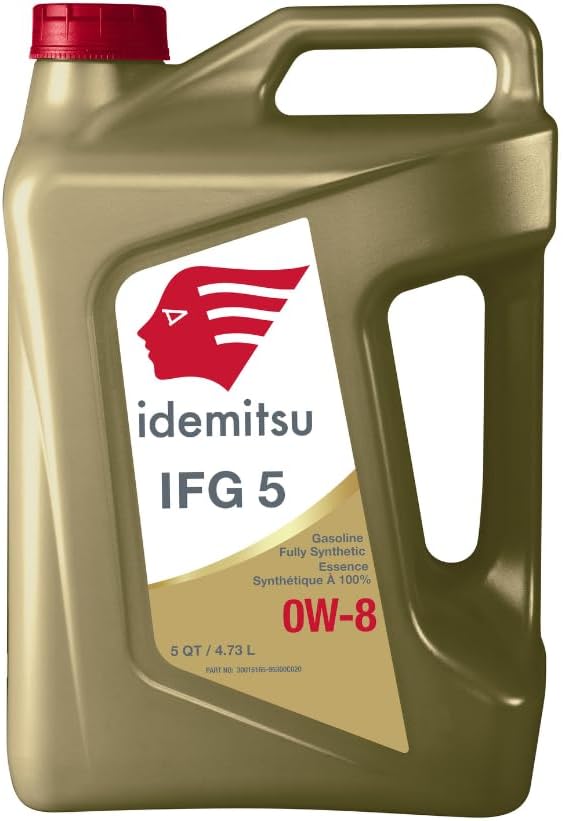
Idemitsu IFG 5 0W-8
0W-8 relies on advanced additive chemistry, particularly molybdenum (Mo-DTC) and calcium borate, to create a protective film in boundary lubrication zones where metal surfaces come dangerously close to direct contact. These additives form a chemical layer that prevents wear even when the oil film itself is microscopically thin. It’s a completely different approach from the older mindset of “thicker is better.”
Idemitsu IFG 5 0W-8 is a prime example of this technology. As a major supplier for Japanese automakers, Idemitsu uses what they call ‘Quintet Guard’ to ensure the oil resists sludge and maintains its thin profile even under the stress of hybrid cycling.
Despite being so thin, 0W-8 keeps engines cleaner than many thicker oils. The fully synthetic formulation resists deposit formation and sludge buildup. After all, it’s designed for engines that don’t have the tolerance for sludge buildup.
Resists chemical degradation better
0W-8 formulations also resist chemical degradation better. Because the base oil is already so thin, it requires fewer viscosity improvers (polymers that help oil maintain viscosity across temperature ranges). High-viscosity multi-grade oils need more of these improvers, which tend to break down over time and contribute to oxidation.
Better fuel economy
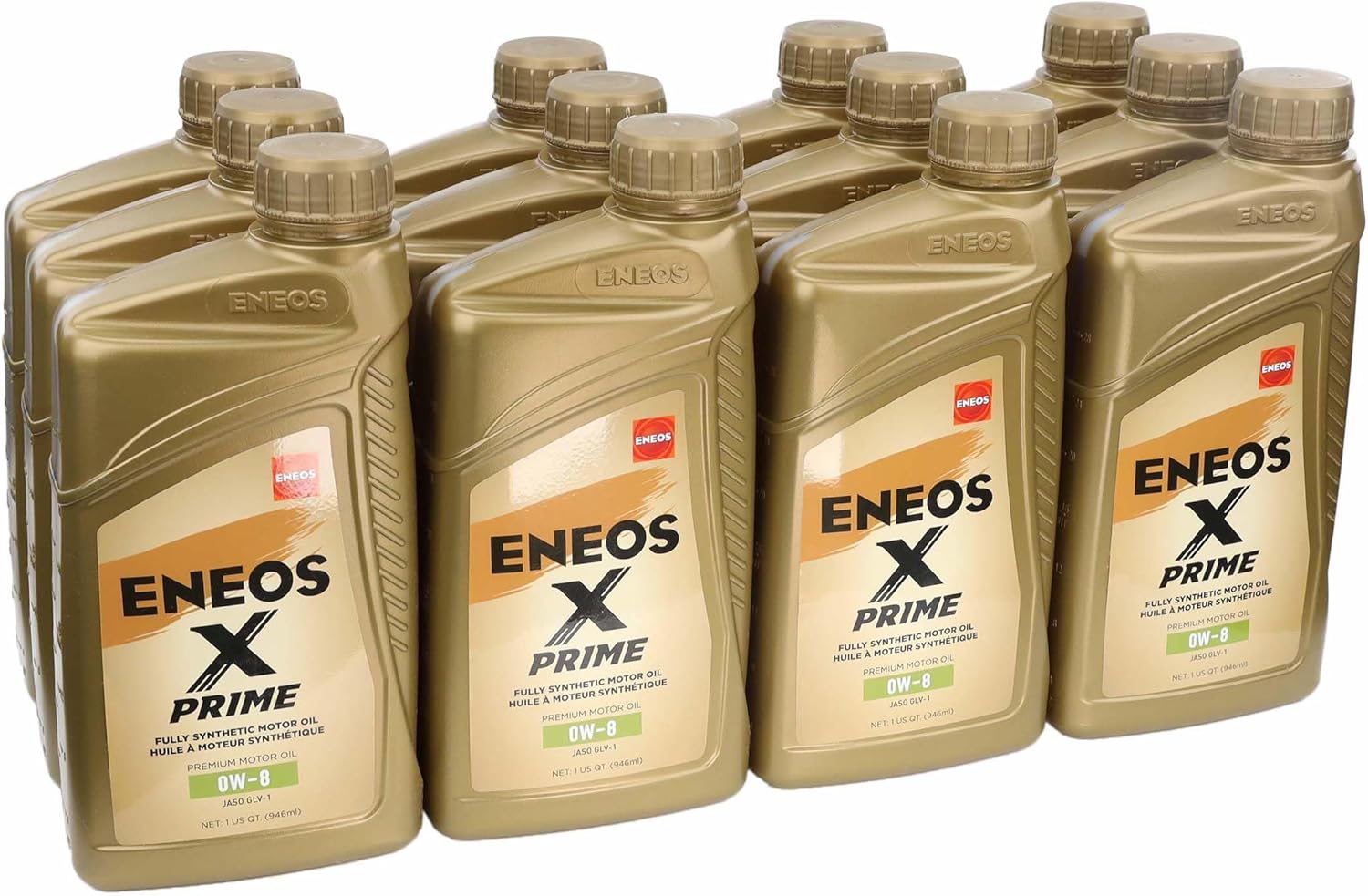
ENEOS X Prime 0W-8 Fully Synthetic
Switching from 0W-16 to 0W-8 provides roughly 0.8% better fuel economy by reducing parasitic friction inside the engine. That means the engine wastes less energy just moving its own internal components.
For a single driver, 0.8% might translate to an extra 20 or 30 miles per tank depending on the vehicle. For manufacturers trying to meet fleet-wide CAFE standards, that 0.8% is the difference between compliance and penalties.
The regulatory pressure is what’s really driving the adoption of 0W-8. EPA and CAFE mandates keep tightening, and CO2 emissions targets get stricter every few years. Ultra-low viscosity oils give manufacturers a way to hit those numbers without completely redesigning powertrains.
Modern engines are also built with tolerances that older mechanics would find absurd. Toyota’s Dynamic Force engines, for example, have oil passages and bearing clearances measured in microns. Thicker oils struggle to flow through these tiny gaps fast enough, especially during cold starts. 0W-8 moves through these passages instantly, which is exactly what the engineers designed for.
Which Cars Use 0W-8 Motor Oil
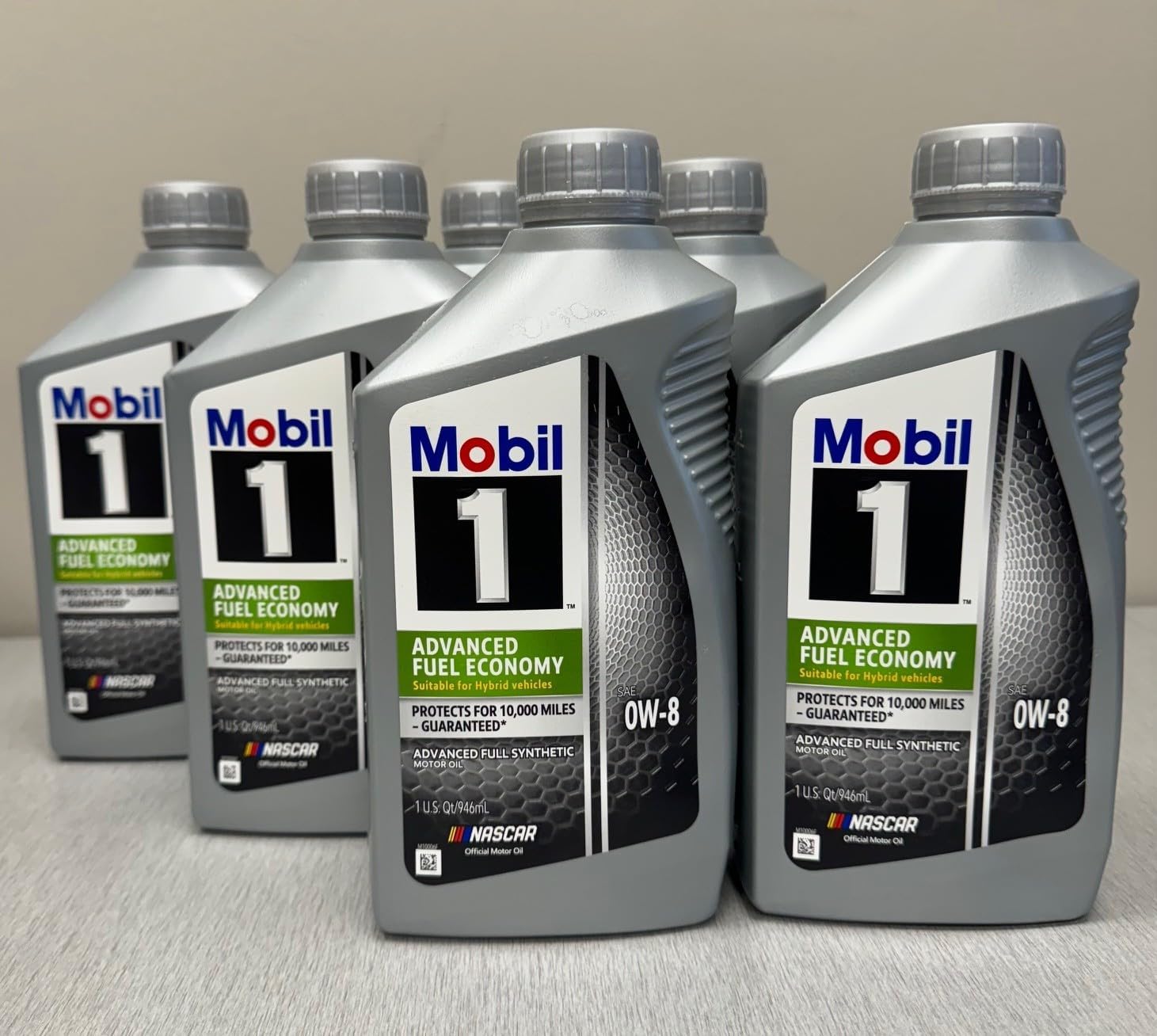
Mobil 1 Synthetic Motor Oil 0W-8 JASO GLV-1-6
Most 0W-8 oils meet the JASO GLV-1 specification, which is Japan’s standard for ultra-low viscosity oils. JASO GLV-1 is equivalent to API SP Resource Conserving, so you’re looking at the same performance targets either way.
While 0W-8 sets a new bar for thinness, understanding how it stacks up against standard grades like 0W-20 vs 5W-20 can help clarify why modern high-efficiency engines require such specific essential fluids and API SP formulations.
Toyota and Mazda were the first manufacturers to spec 0W-8 for production vehicles in North America.
The 2025 Camry requires 0W-8 across the entire lineup because Toyota went hybrid-only for that model year. You’ll also find it specified for the 2023 and newer Corolla 2.0, the 2024 and newer Corolla Cross, and certain trims of the 2022 and newer Crown 2.5L (specifically Limited and XLE). The Grand Highlander 2.5 Hybrid from 2023 forward uses it, along with the Yaris 1.5 Hybrid and Yaris Cross 1.5 Hybrid from 2020 and 2021 respectively.
Mazda specs 0W-8 for the Mazda 2 Hybrid 1.5 from 2022 onward.
If you are looking for European-engineered quality for your Japanese hybrid, Liqui Moly Special Tec is specifically tuned for the ‘AA’ (Asian and American) market requirements

Liqui Moly Special Tec AA 0W-8
Whether you can use 0W-8 depends entirely on what your engine was designed for. Older engines are off-limits for 0W-8. These engines were built with larger tolerances between moving parts because manufacturing precision wasn’t what it is today.
Bearings, piston ring gaps, and valve stem clearances are all measured in larger increments. 0W-8 is so thin that it can’t create the oil film thickness needed to keep metal surfaces separated in an older engine. The consistency really is close to water or coolant. If you dump 0W-8 into a 20-year-old engine, it would lead to metal-on-metal contact, accelerated wear, and potentially a seized motor.
Heavy loads and towing present an interesting question. Some Toyota owners manuals, including the Corolla Cross, explicitly state that higher viscosity oils may be better suited for heavy loads or extreme conditions.
In practice, some drivers have run 0W-8 successfully while carrying 500-pound payloads on long trips in high heat, but they’re using high-quality formulations from reputable brands.
High-mileage engines can run 0W-8 as long as they were originally designed for it. Whether this happens depends on the condition of the engine and how well it’s been maintained. A well-maintained engine designed for 0W-8 should handle it fine at high mileage. A neglected engine might not.
For those hitting high mileage markers, Valvoline Advanced Full Synthetic 0W-8 and Castrol EDGE 0W-8 are popular choices. Both brands focus heavily on anti-wear additives that help maintain that microscopic protective film as engine components age.

Valvoline Advanced Full Synthetic 0W-8
Hot climates and high-speed driving don’t disqualify 0W-8. Advanced synthetic formulations are designed to provide protection at internal engine temperatures up to 500°F. Drivers in areas with ambient temperatures of 110°F have reported reliable performance. The oil’s resistance to oxidation and breakdown is strong even during sustained highway driving.
The analogy of a silk glove versus a leather work glove captures it well. 0W-8 is a precision lubricant for a precision engine. It provides a perfect, slippery protective layer for components machined to microscopic tolerances. Older engines with looser tolerances need a thicker oil to fill the gaps and maintain separation between surfaces. Using 0W-8 in an older engine is like wearing a silk glove to do heavy construction work.
While the major brands dominate the shelves, options like Prime Guard Full Synthetic 0W-8 offer a cost-effective way to stay within warranty requirements. It still carries the necessary JASO GLV-1 certification required for modern hybrids.

Prime Guard Full Synthetic 0W-8
Difference Between 0W-8 and 0W-16

Idemitsu IFG 5 0W-16 Motor Oil Full Synthetic
At operating temperature (100°C), 0W-16 runs between 5.8 and 8.2 mm²/s in kinematic viscosity. 0W-8 sits between 4.0 and 5.8 mm²/s. That makes 0W-8 roughly 25% thinner than 0W-16.
Because 0W-8 has less physical cushion, it relies more heavily on chemical friction modifiers to prevent metal-on-metal contact. 0W-16 still uses additives, but it has more viscosity to work with. 0W-8 is almost entirely dependent on its additive package for protection in boundary lubrication zones where surfaces come closest together.
0W-16 was recognized by the API years before 0W-8 showed up. 0W-8 follows the JASO GLV-1 specification, which is a Japanese standard for ultra-low viscosity oils that ENEOS helped develop. JASO GLV-1 is equivalent to API SP Resource Conserving, but the specification came from Japan because that’s where the demand for 0W-8 started.
In engines with extremely tight tolerances, 0W-16 or 0W-20 struggles to move through narrow passages as quickly as 0W-8.
Whether you can substitute 0W-20 or 0W-16 for 0W-8 depends entirely on what your owner’s manual says. Toyota manuals for vehicles like the Yaris Cross and Corolla Cross state that you can use 0W-16 or 0W-20 temporarily if 0W-8 isn’t available, but you must switch back to 0W-8 at the very next oil change.

Valvoline Extended Protection Full Synthetic 0W-20
The problem with running a thicker oil permanently comes down to how modern engines manage oil pressure. Engines designed for 0W-8 use variable discharge oil pumps controlled by the ECU. These pumps adjust output based on engine speed, load, and temperature. The system is calibrated for 0W-8’s flow characteristics.
When you use a thicker oil like 0W-20, the pump detects higher oil pressure and the ECU may dump excessive oil to compensate. This can lead to insufficient oil volume flow to parts of the engine, which is the opposite of what you’d expect from using a thicker oil. You could lose 10% in fuel economy if you use a thicker oil.
Variable Valve Timing systems add another layer of complication. VVT systems use oil pressure to actuate camshaft position changes. Using a significantly thicker oil like 0W-20 can cause these systems to respond more slowly because the oil doesn’t flow as quickly through the control solenoids. This can lead to sluggish performance or trigger a Check Engine light.
Toyota’s warranty procedure for lubrication-related issues involves sending an oil sample for analysis to verify the correct grade was used. If they find you’ve been running 0W-20 when the engine calls for 0W-8, your warranty claim gets denied.
Never permanently up-gauge to a thicker oil unless your manual explicitly lists it as an alternative for specific driving conditions. If your manual says 0W-8, that’s what the engine needs.
Closing Note
We’re moving away from relying on a physical cushion of thick oil and toward a chemical shield created by molecular additives. If you grew up changing oil in engines that called for 10W-30 or 10W-40, the idea of water-thin oil feels wrong. It goes against decades of conventional wisdom that said thicker is safer. But the data doesn’t support that view anymore. In a modern high-efficiency powertrain with tolerances measured in microns, 0W-8 is a requirement.
The engines are different now. The oil pumps are different. The bearing clearances are different. Everything is engineered to work together as a system, and 0W-8 is part of that system. Trust the engineering, follow your manual, and understand that the future of lubrication is measured in microns, not just thickness.