Cold temperatures make gear oil thicker. In freezing weather, standard 75W-90 oil can get so thick it barely flows.
Gear oil that can flow in cold weather is important because your gears and bearings need oil moving through them right away. If the oil is too slow to circulate, metal parts rub against each other before they’re protected, which causes wear.
Recommended 75W-90 Gear Oil for Cold Weather
Here’s how six leading 75W-90 synthetic gear oils compare on cold-weather performance, based on their published specs and available customer feedback.
Motorex Penta LS SAE 75W/90 GL-5

Motorex Penta Limited Slip 75W-90 Gear Oil
Motorex Penta LS SAE 75W/90 GL-5 is a fully synthetic gear oil built for axles with limited-slip differentials. Motorex rates its pour point at -57°C, with a Brookfield viscosity of 37,575 mPa·s at -40°C, which means the gear oil works in serious cold.
It carries GL-5 LS approval plus several ZF certifications. Its high viscosity index (172) means it resists thinning and thickening as temperatures swing.
Mobil 1™ Syn Gear Lube LS 75W-90

Mobil 1 75W-90 Limited Slip Gear Oil
Mobil claims outstanding low-temperature fluidity down to -50°C for some formulations. Its datasheet backs that up with a -39°C pour point.
Online reviews are mostly positive. One long-time user on an enthusiast forum called it the smoothest cold-shifting fluid they’d tried.
Syn Gear Lube LS 75W-90 carries GL-5 approval and a high viscosity index (146), which means it resists thinning in heat and thickening in cold.
Lucas Oil Synthetic SAE 75W-90 Gear Oil

Lucas Oil Synthetic 75W-90 Gear Oil
Lucas Oil Synthetic SAE 75W-90 Gear Oil synthetic gear oil carries a -30°C pour point. That might be a bit higher (less cold-tolerant) than some competitors. But it still holds a 4.8 out of 5 rating across 218 reviews, with 95% of customers recommending it.
Reviewers report smoother shifting and less transmission noise after switching. One user quieted a persistent clunk in a 1999 Harley Fatboy. Its high viscosity index (166) means it resists thinning and thickening across temperature swings.
Valvoline Advanced Full Synthetic 75W-90

Valvoline SynPower 75W-90 Gear Oil
Valvoline rates this oil for -50°F to 300°F. That’s one of the widest ranges in this lineup. It carries GL-5 approval and includes a built-in limited-slip friction modifier.
Most Ford, Chrysler, and GM gear boxes won’t need extra additives when using this oil. However, some car owners warn that the thin fluid runs like water and can spill if handled carelessly.
TRIAX Synergy Gear Max 75W-90 GL-5

TRIAX Synergy Gear Max 75W-90 GL-5 Gear Oil
TRIAX rates this fully synthetic oil for extended drain intervals, up to 500,000 miles in passenger vehicles. It holds a high shear stability rating, meaning it stays in grade through both hot and cold extremes.
TRIAX Synergy Gear Max 75W-90 carries GL-5 Limited Slip approval and includes built-in friction modifiers. A RAM 1500 owner confirmed the limited-slip function worked without extra additives. Reviewers report quieter differentials after switching.
Royal Purple Max Gear 75W-90
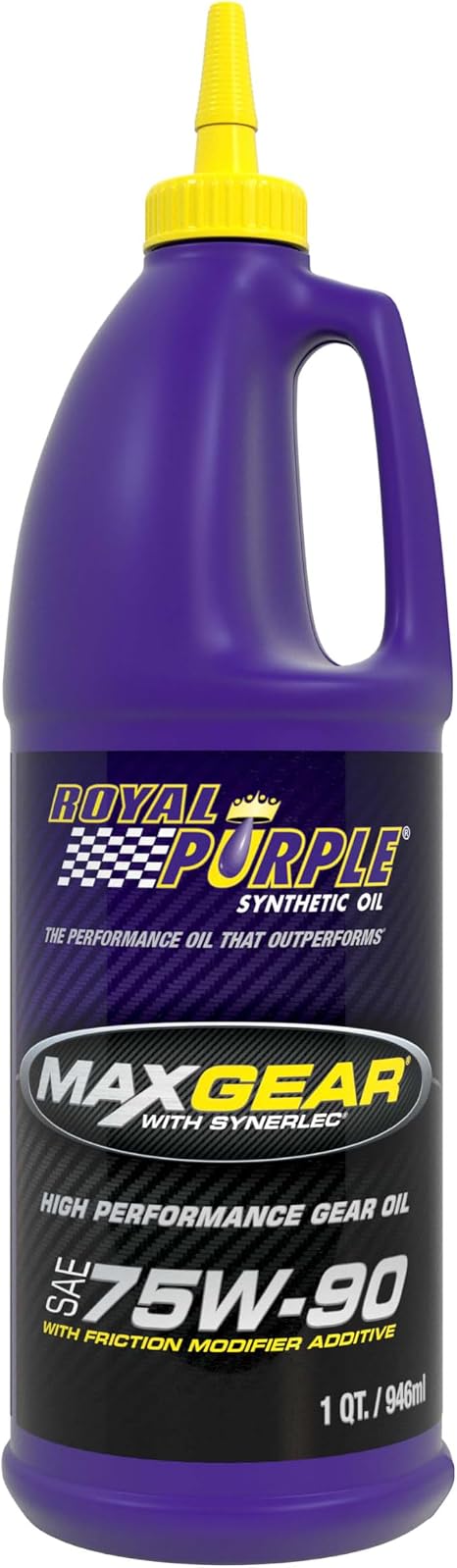
Royal Purple Max Gear 75W-90 Gear Oil
Royal Purple Max Gear 75W-90 holds a pour point of -51°C, backed by a Brookfield viscosity of 65,000 cP at -40°C. It is GL-5 and GL-4 rated, and includes a built-in limited-slip friction modifier.
Effect of Cold Weather on Gear Oil
Cold makes itself known in a few specific ways once you’re behind the wheel. Shifting a manual transmission gets harder, since thick oil makes the gearbox feel sluggish and shifting into first or second can feel notchy or even grind.
Startup wear also increases, because oil that can’t flow fast enough can’t reach and coat the gears and bearings right when you start driving. That gap in protection can scar heavily loaded gear surfaces.
Cold oil also adds resistance to moving parts. This puts extra strain on the system and can make starting the vehicle tougher in freezing weather.
In extreme cold, oil quality matters even more. Every oil has a pour point, the temperature where it stops flowing altogether. Lower-quality or non-synthetic oils can hit that point in harsh winters, leading to a total loss of lubrication.
Many synthetic oils are built to keep flowing down to -45°F or even -60°F, which is why they’re the safer bet for anyone facing serious winter conditions.
What to look for in a winter-grade gear oil
A handful of specs tell you how well an oil will actually hold up in the cold, and they’re worth comparing side by side:
- Pour point: look for -45°F to -60°F if you deal with serious winter weather. That range keeps the oil from turning solid.
- Brookfield viscosity: measures resistance at very low temperatures, like -40°C. A lower number, such as 101,000 cP, means less drag and smoother cold-weather shifting.
- API service classification: GL-5 is standard for most differentials because of its stronger extreme-pressure additives. GL-4 is often required for manual transmissions with yellow-metal synchronizers, since GL-5’s additives can corrode that metal.
- Base oil type: full synthetic oils generally flow better in the cold and hold up longer than conventional oils.
Closing Notes
If you drive in mild winters and stick to daily commuting, a standard 75W-90 oil with a decent W rating is probably enough. 30,000 to 50,000 miles is the typical change schedule but best to check what your owner’s manual says.
If you live somewhere with real winter cold, tow regularly, or go off-road, it’s worth spending more on a full synthetic with a low pour point (-45°F or colder) and shortening your change interval to around 15,000 miles. Regardless of climate, if your axle ever goes underwater, change the oil right away rather than waiting for the next scheduled service.
Related Reads
- GL-4 vs. GL-5 gear oil, what’s actually different? – The chemical differences between these two specs, and why using the wrong one can corrode yellow-metal synchronizers.
- How Valvoline and Pennzoil gear oils really compare – How these two brands stack up across their synthetic and standard lubricant lineups.
- Lucas or Seafoam, which additive should you use? – How these two popular maintenance additives differ if you’re looking to treat your drivetrain or engine.