
MB 229.52 is a modern engine oil standard that Mercedes-Benz introduced around 2012. It was built mainly for BlueTEC diesel engines that use advanced exhaust systems like Diesel Particulate Filters (DPF) and Selective Catalyst Reduction (SCR).
In the US, this spec is required for most modern Mercedes diesel vehicles and vans, along with a handful of newer turbocharged gasoline models.
Sprinter Vans need it for 2010 to 2022 models running the 3.0L V6 (OM642) or the 2.1L (OM651) diesel engines. It’s also the spec for the newer OM654 diesel engines in 2024 and later models. Several BlueTEC SUVs and sedans with the OM642 or OM651 engines need it too:
- ML-Class and GLE-Class: ML250, ML320, ML350 BlueTEC, GLE300d
- GL-Class and GLS-Class: GL320, GL350 BlueTEC
- GLK-Class: GLK250 BlueTEC
- E-Class: E250, E320 CDI/BlueTEC, E350 BlueTEC
- S-Class: S350 BlueTEC
- R-Class: R320, R350 BlueTEC
Newer EPA rules led to Gasoline Particulate Filters (GPF) on some models. To prevent a problem called Low-Speed Pre-Ignition (LSPI), Mercedes recommends MB 229.52 for certain 2.0L turbo gas engines starting in 2019, including the C300, E350, GLE350, and the AMG GLB35 and CLA35.
Drivers who want to protect high-output engines from pre-ignition can check out how API SP and newer specs handle LSPI.
Motor Oils that Meet MB 229.51
MB 229.51 oils need to hit a few key numbers: viscosity grades of 0W-30, 5W-30, or 5W-40, a minimum HTHS of 3.5 mPa·s, and a TBN of 6.0 or higher. They’re made with Group III base oil, or a mix of Group III and IV.
Moreover, these motor oils fall under the Mid-Low SAPS category, meaning ash, phosphorus, and sulfur are kept low to protect the DPF.
Motul 6100 SYN-Clean SPEC 5W-40

Motul 6100 SYN-Clean SPEC 5W-40 Motor Oil
Motul 6100 SYN-Clean SPEC 5W-40 meets the performance requirements for MB 229.51, though it’s not officially licensed by Mercedes-Benz.
Quick specs:
- ACEA C3, API SN
- HTHS: above 3.5 mPa·s
- Sulfated ash: 0.8% or less
- Phosphorus: 0.07% to 0.09%
- Sulfur: 0.3% or less
Motul 6100 SYN-Clean SPEC 5W-40 is a good fit for drivers who want a Mid-SAPS oil for a DPF-equipped engine without paying for full factory licensing.
One mechanic uses it as their go-to choice for European cars. Another driver compared it to Motul’s higher-tier 8100 series and said the pricier oil ran smoother, suggesting the 6100 is a solid mid-range pick rather than a top-tier one.
Other compatibility:
- BMW Longlife-04 (through 2018 models)
- VW 505 00 / 505 01
- Renault RN0710 / RN0700
- Ford WSS-M2C917-A
RAVENOL HLS SAE 5W-30
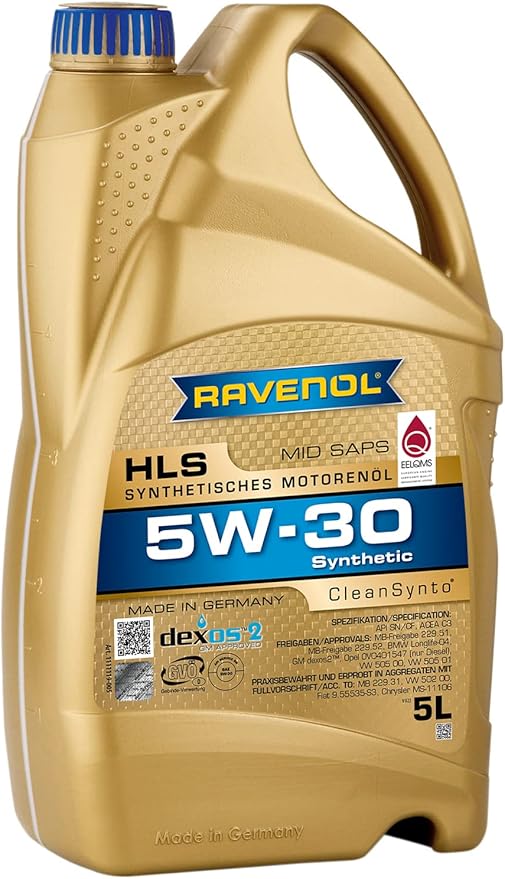
RAVENOL HLS 5W-30 Synthetic Motor Oil
RAVENOL HLS SAE 5W-30 is officially licensed by Mercedes-Benz for MB 229.51 (and 229.52).
Quick specs:
- HTHS at 150°C: 3.68 mPa·s
- TBN: 7.8 mg KOH/g
- Sulphated ash: 0.69%
- Pour point: -39°C
RAVENOL HLS SAE 5W-30 fits diesel and gas engines, turbocharged or not, that need a Mid-SAPS oil with full factory backing.
Customers give it a 98 to 99% satisfaction rating. Many use it in Mercedes BlueTEC diesels, including Sprinter, E-Class, and ML models, as well as GM 1.6L and 2.8L diesels.
Reviewers point to it as a reliable choice for keeping high-mileage European engines clean and protected long-term.
Other compatibility:
- BMW Longlife-04
- GM dexos2
- VW 502 00, 505 00, 505 01
- MB 226.52, 229.31
- Chrysler MS-11106
- Renault RN17
TRIAX Euro VX 5W-30

TRIAX Euro VX 5W-30 Synthetic Ester Motor Oil
TRIAX Euro VX 5W-30 claims full compliance with MB 229.51, though this is a manufacturer claim rather than an official Mercedes-Benz license.
Quick specs:
- Full synthetic PAO/ester blend with moly and boron friction modifiers
- Low ash formula built for DPF and SCR systems
- Drain interval: over 25,000 miles or 2 years
- ACEA C3
TRIAX Euro VX 5W-30 fits drivers who want long drain intervals and strong turbo protection in a low-ash formula for DPF-equipped engines.
It holds a 4.6 out of 5 rating across 126 reviews.
Other compatibility:
- VW 507.00/504.00, 502.00, 505.01
- BMW Longlife-04
- MB 229.5, 229.31
- Porsche C30
Pento High Performance II 5W-40

Pentosin High Performance II 5W-40 Full Synthetic Motor Oil
Pento High Performance II 5W-40 carries an official Mercedes-Benz approval for MB 229.51, along with 226.5, 229.31, and 229.52.
Quick specs:
- Viscosity Index: 185
- Pour point: -42°C
- Flash point: 228°C
- ACEA C3, API SN
Pento High Performance II 5W-40 fits modern, downsized engines, including those with stop-start systems, where reduced SAPS content protects the exhaust aftertreatment system.
Other compatibility:
- VW 511.00
- BMW Longlife-04
- Porsche C40
Do NOT Use MB 229.5 as a Substitute for 229.51
MB 229.5 is for gasoline engines and older diesels that don’t have a Diesel Particulate Filter (DPF). It has a high Total Base Number (TBN) of 10.0 or higher, which means it’s better at neutralizing acid buildup over long stretches between oil changes.
MB 229.51 is a “low ash” oil. It’s built for modern diesels with a DPF, and newer gas engines with a similar filter (GPF). It has a lower TBN, around 6.0, because the additives that raise TBN are also the ones that create ash. Too much ash clogs the fine pores in a DPF.
If you put 229.5 in a car that needs 229.51, the extra ash builds up inside the DPF over time. Unlike soot, ash doesn’t burn off during a regeneration cycle. It just sits there and slowly chokes the filter. Once that happens, you’re usually looking at a costly filter replacement, not just an oil change.
Closing Notes
Before we wrap up, let’s have a quick look into MB 229.52.
MB 229.52 is the newer spec, built to eventually replace 229.51. Both are Low SAPS oils made for modern engines with emission systems like DPFs, but 229.52 raises the bar in a few key areas.
MB 229.52 requires at least a 0.7% to 1% better fuel economy than 229.51. It also holds up better against oxidation, which matters more now since biodiesel breaks down faster than regular diesel.
Motor oils that meet MB 229.52 flow better in cold weather too. They also need to pass a test for Low Speed Pre-Ignition (LSPI).
The good news is that 229.52 is fully backward compatible with 229.51. So if your engine calls for 229.51, you can use 229.52 instead without any issues.
That said, it doesn’t work the other way around. Some newer engines require 229.52 specifically, and 229.51 isn’t a safe substitute for those.