Skip to content
Used correctly, penetrating oils can free stuck piston rings, loosen corroded fasteners, and coax a dormant engine back to life without a full teardown. The catch is that success depends heavily on the severity of the seizure, and penetrants almost always work better alongside heat or mechanical force rather than as a standalone fix.
Types of Penetrating Oils
Commercial sprays are the most accessible starting point for penetrating oils. Kroil is widely regarded as the top performer, though it carries a price premium and can be hard to find locally.
PB Blaster is the more common choice, particularly in rust belt regions where it has a long track record of creeping into corroded threads. Marvel Mystery Oil (MMO) takes a different approach: it’s a thin oil typically poured directly into spark plug holes to soak seized pistons from above. Liquid Wrench and Seafoam Deep Creep round out the common commercial options.
Modern penetrating oils sometimes use ester-based formulations. Esters are polar molecules, which allows them to migrate into tight spaces like ring packs that conventional oils struggle to reach.
Home-brew mixtures come up often in technical forums, and some have legitimate backing. A 50/50 mix of ATF and acetone is frequently cited as one of the most effective penetrants available, often outperforming commercial sprays on stubborn fasteners.
Diesel fuel works well for long-term soaking of heavily rusted components. Other combinations, like ATF and kerosene or diesel mixed with brake fluid, get experimented with regularly, though results vary.
Benefits of Engine Penetrating Oils
The strongest case for penetrating oils is cost. A lightly seized piston that responds to a penetrant soak can mean the difference between a straightforward DIY fix and a five-figure repair bill. The fix for lightly seized pistons is simple: soak the cylinders, wait, and attempt to rotate the engine by hand before introducing any power.
Products like MMO also function as slow-acting detergents. Over time, they break down carbon deposits, sludge, and varnish from internal components like lifters. This makes them useful not just for unseizing but for cleaning up neglected engines before a restart.
For any engine that has sat for an extended period, penetrating oil also addresses the dry cylinder walls and rings directly. Providing lubrication before the first attempted start reduces the risk of scoring on initial turnover.
Limitations of Penetrating Oils
For a genuinely seized engine, the odds are roughly 50/50. Even when a penetrant succeeds, it does not restore the engine to its original condition. Rust on cylinder walls remains after the piston breaks free, and once the engine is running, that rust will accelerate wear on new piston rings quickly.
Make sure that the product you choose is compatible with your engine seals. Esters can cause seals to swell. PAOs (polyalphaolefins) can cause them to shrink. Neither outcome is desirable in a functional engine, so matching the penetrant chemistry to your application matters.
WD-40 is worth mentioning specifically because it gets used as a penetrant despite not being formulated for that purpose. It leaves a gummy residue that can cause parts to bind over time, making the original problem worse.
Overuse of MMO in the fuel system carries its own risk. Adding too much to the fuel tank can damage catalytic converters, so follow dosing guidance carefully if you’re using it as a fuel additive rather than a direct cylinder treatment.
Popular Penetrating Oils
Quick note: None of the products below are marketed specifically for engine seizure. They’re general-purpose penetrants, and that’s the honest category most of these jobs fall into anyway.
Kroil Penetrating Oil

Kroil Aerokroil Penetrant
Kroil is the penetrant that gets recommended most often when other products have already failed. It’s been in professional toolboxes since 1939, and that track record is the main reason it keeps coming up in technical forums and shop conversations.
The formula is built around capillary action. Kroil works its way into openings that are too small for most penetrants to reach, which is where badly corroded fasteners tend to fail other products. It loosens, lubricates, removes rust, and displaces moisture in one application.
The price is higher than most alternatives. For a one-off seized bolt on a weekend job, that may be hard to justify. For a mechanic or technician dealing with corroded fasteners regularly, the cost per job is easier to rationalize.
3-IN-ONE Penetrant

3-IN-ONE Fast-Acting Penetrant Drip Oil
3-IN-ONE Penetrant is a general-purpose penetrating oil that handles light to moderate corrosion across a wide range of surfaces and temperatures.
The low viscosity lets it migrate into tight joints quickly. It also leaves a protective film after application, which means it’s doing two jobs: freeing the stuck part and slowing down further corrosion. Salt spray testing shows less than 25% surface corrosion after 72 hours.
It’s safe on plastic, metal, and rubber surfaces, though you should avoid fully immersing rubber components in it.
3-IN-ONE Penetrant is a practical choice for general shop use, home maintenance, and light automotive work. Not the right tool for heavily seized components or industrial applications.
CRC Screwloose Super Penetrant

CRC Screwloose Super Penetrant
CRC Screwloose is an industrial-strength penetrant built specifically for frozen fasteners in plant and equipment environments, with independent test data to back up its penetration claims.
The low surface tension formula creeps into cracks, seams, and threads faster than most competitors, covering 10.2 cm in one minute on capillary testing. The 360-degree valve means you can spray it in any position, including upside down, which matters when you’re working in tight or awkward spaces. No dyes in the formula, so there’s no residue cleanup afterward.
NSF H2 registered for use in meat and poultry processing environments, which puts it in a different category than most consumer penetrants.
CRC Screwloose is built for maintenance technicians and industrial users dealing with seized equipment under time pressure.
Free All Deep Penetrating Oil
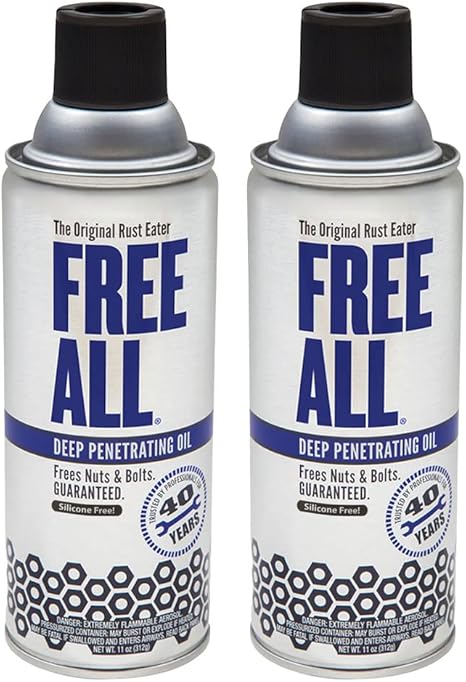
Free All Rust Eater Deep Penetrating Oil
Free All is a silicone-free penetrating oil designed to dissolve rust, scale, and corrosion on stuck components across automotive, plumbing, marine, and industrial applications.
Most shop environments and paint areas can’t tolerate silicone contamination, and most penetrants carry it. Free All is safe to use around painted surfaces without risk of fish-eye or adhesion issues down the line.
Beyond rust, it also loosens tar, grease, carbon, and graphite deposits, making it useful for more than just stuck fasteners.
This penetrating oil is practical for mechanics and shop techs who need a penetrant they can use freely without worrying about overspray contaminating nearby surfaces.
- Automotive, plumbing, marine, and industrial use
- Safe in paint and body shop environments
Sea Foam Deep Creep

Deep Creep Penetrating Oil & Lubricant Spray
Deep Creep is a penetrating oil and lubricant from Sea Foam that handles both stuck fasteners and ongoing lubrication, which makes it more versatile than single-purpose penetrants.
The formula is built to migrate along metal surfaces and into tight thread contact areas. It breaks surface tension quickly, which helps when you’re dealing with rust and corrosion that has seized a fastener in place.
Unlike some penetrants that evaporate shortly after application, Deep Creep resists evaporation and holds up under temperature extremes, so it continues working as a lubricant after the stuck part is freed.
Trick Shot Penetrating Lubricant

Trick Shot – 3-in-1 Penetrating Lubricant Oil
Trick Shot is a bio-based penetrating lubricant made from modified soybean oil, built for users who need strong penetration performance without the environmental and safety concerns that come with petroleum-based products.
The 371°F flash point is what separates it from most penetrants on this list. In liquid form, it’s non-flammable, which makes it usable in proximity to welding, heating elements, and electrical components where a petroleum-based spray would be a fire risk.
The 96% biobased carbon content is USDA certified, and it passes rust testing in both deionized water and synthetic sea water over a 4-hour run. It’s also 100% biodegradable and EAL-VGP qualified, meaning it meets the environmental requirements for use near groundwater and aquatic environments.
Trick Shot is best suited for industrial users, food processing environments, and anyone working in marine or environmentally regulated settings where a conventional penetrant isn’t appropriate.
Closing Notes
Penetrating oil works better with help. Clean the area first so crud isn’t blocking access, then combine the fluid with heat cycles and mechanical tapping to drive it deeper into the threads.
Ester-based formulas migrate into tight spaces like ring packs that gravity alone won’t reach. That same property is why the ATF and acetone home-brew doesn’t store well. Mix it fresh.
If the seizure was caused by oil starvation, the bearings are likely already gone. No penetrant fixes that.
Can’t find what you’re looking for? These two products are staples in tool sheds everywhere. You might consider getting your hand on these:

Made Here Multi-use Lubricating Penetrant Oil

DEWALT 3 in 1 Multi Purpose Biodegradable Penetrating Oil
Related Reads:
- Unparalleled Penetrating Oils for Rusted Nuts and Bolts Discover the top penetrating oils that can effectively prevent engine jamming by tackling rusted components – Learn more.
- Marvel Mystery Oil Review See how Marvel Mystery Oil performs as a penetrating oil to keep your engine running smoothly and prevent jamming – Read more.
- BG 44K vs Seafoam: Head-to-Head Comparison Compare the effectiveness of BG 44K and Seafoam as penetrating oils to find the ultimate solution for engine jamming – Find out more.
- Lucas Vs Seafoam: Head-To-Head Comparison Explore how Lucas and Seafoam penetrating oils measure up in preventing engine jamming and enhancing performance – Explore here.
- Should I Use K&N Air Filter Oil Substitute? Learn about alternatives to K&N Air Filter Oil and their effectiveness in preventing engine jamming and improving longevity – Discover now.