You do not need a hybrid-specific formula. Any standard synthetic 0W-16 oil is safe to use as long as it meets the API SP and ILSAC GF-6B (or newer) specifications listed in your owner’s manual.
Hybrid engines shut off and restart constantly while you drive. In freezing weather, these constant cold starts mean the engine never reaches full operating temperature. It needs 0W-16 oil because it stays thin enough to flow instantly.
The “0W” means the oil stays thin and flows easily down to -35°C. Most engine wear happens in the first few seconds after a cold start. Thin oil lubricates the engine faster, whereas thick oil struggles to circulate in winter. A cold engine burns fuel less efficiently until it warms up.
On top of that, hybrids restart the gas engine over and over during a single drive. Thinner oil means less strain on that process.
Recommended 0W-16 Motor Oils for Hybrid Vehicles
Here’s a look at 0W-16 oils currently on the market. Each entry covers what the brand claims and what owners have reported.
Motul Hybrid 0W-16

Motul 0W-16 Hybrid Motor Oil
Motul Hybrid 0W-16 is 100% synthetic “Fuel Economy” oil built for hybrid and plug-in hybrid vehicles. It is officially recommended for Honda, Suzuki, and Toyota models requiring 0W-16. It meets API SP and ILSAC GF-6B standards and is formulated to handle frequent restarts, fuel dilution, and water contamination from short engine run times.
To better understand how these standards protect low-clearance engines, take a look at ILSAC GF-6 engine oils and the performance targets they’re built around.
LIQUI MOLY Special Tec AA 0W-16

LIQUI MOLY Special Tec AA 0W-16
LIQUI MOLY Special Tec AA 0W-16 is a fully synthetic oil developed for modern Asian and American engines. It is officially recommended for Honda, Lexus, Suzuki, and Toyota vehicles.
This motor oil meets API SQ and ILSAC GF-7B standards, the newest specifications; and is suited for engines with direct injection and turbochargers.
LIQUI MOLY states it provides instant lubrication after a cold start and helps reduce pollutant emissions. Forum sentiment on this product is mixed.
Some owners consider it a premium brand on par with Mobil 1 and Motul, while others note it costs more than Toyota Genuine Motor Oil or other common synthetics.
Castrol EDGE 0W-16

Castrol EDGE 0W-16 Full Synthetic Motor Oil
Castrol positions EDGE 0W-16 as the brand’s strongest full synthetic oil. It is recommended for Honda and Toyota vehicles that specify 0W-16, including hybrids.
This motor oil meets or exceeds API SQ, SP, SN PLUS, and SN standards, as well as ILSAC GF-7B, the newest specifications. Castrol claims it delivers 10 times better high-stress performance than standard API SQ limits. The recommended drain interval for this variant is 10,000 miles or one year, whichever comes first.
Customer feedback on this product is largely positive. Some Toyota and Lexus owners reported noticeably smoother engine performance after switching to Castrol. DIY oil-change users often cite it as a reliable, widely available alternative to pricier boutique brands like Liqui Moly.
Idemitsu IFG7 0W-16

Idemitsu IFG7 0W-16 SP/GF-6B Motor Oil
Idemitsu IFG7 0W-16 is a fully synthetic, ultra-low viscosity oil for modern gasoline engines, including turbocharged, direct-injection, and hybrid vehicles requiring 0W-16.
This motor oil meets and exceeds API SP and ILSAC GF-6B standards. Forum and retailer reviews are largely positive, with the product reportedly holding a 4.9 out of 5 rating on international retail sites.
Engine smoothness is the most frequently mentioned benefit, along with noticeable fuel economy gains and strong cold start performance. Owners of Japanese vehicles in particular describe it as well-suited to Japanese engine technology.
Subaru OEM 0W-16 Synthetic Engine Oil

Subaru OEM 0W-16 Synthetic Engine Oil
Subaru OEM 0W-16 is formulated specifically for the Subaru Boxer engine, with recent models like the 2024 Crosstrek and 2025 Wilderness trims specifying this viscosity.
Customer sentiment is split. Many owners prefer it for warranty compliance and trust in Subaru’s own engineering. One user reported an oil consumption issue with Mobil 1 and Liqui Moly that stopped after switching back to Subaru Genuine oil.
Others argue the move to 0W-16 is driven more by fuel economy regulations than engine longevity.
Mobil 1 Advanced Fuel Economy 0W-16
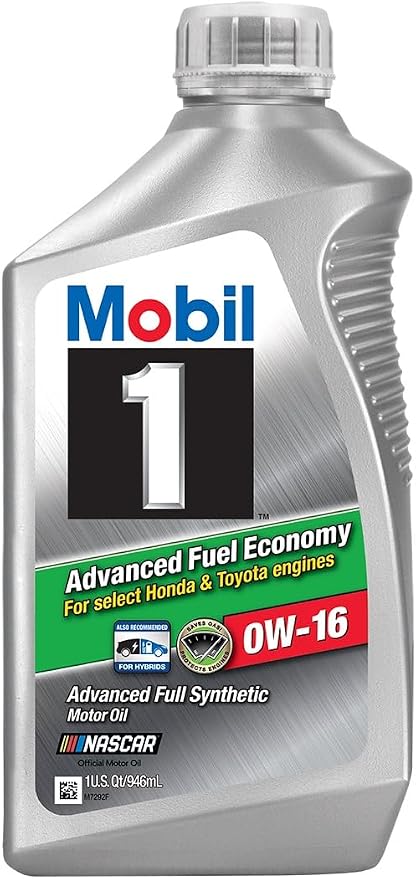
Mobil 1 0W-16 Full Synthetic Motor Oil
Mobil 1 0W-16 is recommended for many Honda and Toyota models requiring 0W-16. It meets API SQ, SP, SN PLUS, and SN standards, along with ILSAC GF-7B. Mobil states it supports a drain interval of up to 15,000 miles or one year, whichever comes first.
Customer ratings average 4.7 to 4.8 out of 5 stars across major platforms. Users frequently report smoother engines, especially on cold starts.
Several car owners noted the oil stayed clean-looking even close to the 10,000-mile mark. On the downside, some find it pricier than store-brand synthetics.
If you’re torn between top brands, you can compare Liqui Moly vs Mobil 1 to see how their formulations and real-world performance stack up.
Do you need “hybrid-specific” 0W-16 oil?
Any 0W-16 synthetic oil that meets your manufacturer’s certifications, such as API SP or ILSAC GF-6B, will work. But some brands make hybrid-specific formulas built to handle the particular stress hybrid engines put on oil.
Hybrid engines run in short bursts and shut off frequently. Because they run for short stretches and stay cooler than a normal engine, condensation builds up more easily. Hybrid formulas use extra inhibitors and dispersants to fight this corrosion.
That same start-and-stop pattern can cause incomplete combustion, which lets unburnt fuel leak into the crankcase. Hybrid-specific oils use stronger viscosity control so the oil still lubricates properly even when diluted by fuel.
However, you can still use a regular 0W-16 oil, as long as it meets the standards listed in your owner’s manual.
Look for API SP and ILSAC GF-6B certifications. These already test for low-speed pre-ignition protection and timing chain wear.
A lot of standard synthetic 0W-16 oils already meet the same performance standards that hybrid formulas are built around. So the gap between “standard” and “hybrid” oil is often smaller than it sounds.
Closing Notes
0W-16 oils generally cost more than 0W-20 due to pricier base stocks like Group IV PAO or Group V esters and additive packages built for hybrid-specific stress.
The thinner viscosity matters mechanically: it flows fast enough to reach tight engine clearances during frequent restarts, and it’s calibrated to work with systems like VVT-i. Most importantly, sticking with the manufacturer’s specified viscosity keeps the engine running as designed and protects your warranty coverage.