Allison TES 668 is a synthetic transmission fluid spec that replaces the older TES 295 standard. 668 lasts longer, protects gears better, and works in any transmission that used to require TES 295 or TES 468.
TES 668 is mainly used in Allison transmissions found in heavy-duty trucks, RVs, buses, and commercial fleets.
TES 668 is the recommended fluid for several Allison transmission series:
- 1000 Series
- 2000 Series
- 3000 Series, including the B300/400 and T200/300 variants
- 4000 Series, including the B500 and T400/500 variants
- 9-Speed Series
It’s also the designated fluid for Allison’s hybrid and electric propulsion systems, including the H 40/50 EP, eGen Flex, and eGen Power lines.
A few older, legacy series are also covered under Allison’s TES 668 service recommendations: the AT 500 Series, MT 600 Series, and HT 700 Series.
Fluids that meet the TES 668 spec
Officially licensed fluids like Castrol TranSynd 668 and CITGO SynDurance 668 that carry Allison’s direct approval. “Suitable for” alternatives like TRIAX meet the same specs without formal certification.
Castrol TranSynd 668

Castrol TranSynd 668 Full-Synthetic ATF
Castrol TranSynd 668 is an OEM-approved fluid, developed with Allison Transmission to meet the TES 668 spec under license number 668-10032020.
Quick specs
- Bright, clear red fluid with a density of 0.8508 g/ml
- Viscosity: 6.9 mm²/s at 100°C, 33 mm²/s at 40°C
- Viscosity index of 168
- Flash point above 210°C, pour point of -51°C
- Supports drain intervals up to 300,000 miles for general-duty use, 150,000 miles for severe-duty use
Castrol TranSynd 668 is best for owners of heavy-duty or on-highway Allison transmissions who want factory-level protection without risking their warranty.
Owners report strong performance in motorhomes and high-heat use, smoother shifting in Allison 1000 transmissions, and an easy fluid change. Some say it costs less than older TES 295 fluid.
Other compatibility
- Backwards compatible with TES 295 and TES 468
- Not approved for TC10 transmissions
CITGO SynDurance 668 ATF
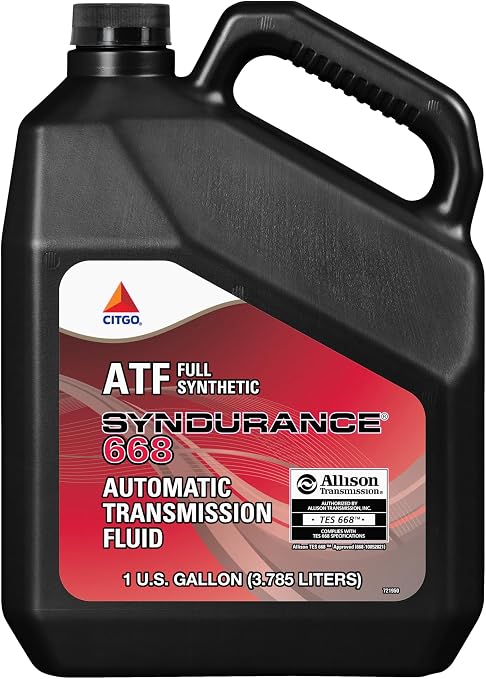
Syndurance 668 ATF – Allison Approved, TES-295 Compatible
CITGO SynDurance 668 ATF is an Allison-approved equivalent to OEM fluid, licensed under approval number 668-10052021 for use anywhere a TES 668 fluid is required.
Quick specs
- Full synthetic, red fluid with an API gravity of 34.7
- Viscosity: 7 cSt at 100°C, 34 cSt at 40°C
- Viscosity index of 168
- Flash point of 207°C (405°F), pour point of -52°C (-62°F)
CITGO SynDurance 668 ATF is formulated for heavy-duty, on-highway and vocational vehicles like refuse trucks and construction haulers, plus Allison’s hybrid H 40/50 EP and eGen Flex systems.
Other compatibility
- Backwards compatible with TES 295, TES 389, and TES 468
- Also approved for Volvo 97341, Dana-OHTM-ATF-X 24D-0014, and Voith H55.6335.xx
TRIAX Fleet HD ATF Full Synthetic

TRIAX Fleet HD ATF Full Synthetic – TES 295 & 668, Long Drain
TRIAX Fleet HD ATF is a full-synthetic fluid the manufacturer calls “suitable for” TES 668 applications, but it is not on Allison’s official approved fluid list as of June 2026.
Quick specs
- Viscosity: 7.4 cSt at 100°C, 35.3 cSt at 40°C
- Viscosity index of 183
- Flash point of 216°C (420°F), pour point of -49°C (-56°F)
- Specific gravity of 0.87 at 60°F
TRIAX Fleet HD ATF is for fleets running severe-service, heavy-duty transmissions who want strong gear protection and reliability across a wide range of temperatures.
How often should you change Allison TES 668 fluid
How often you need to change your Allison TES 668 fluid depends on three things: which transmission series you have, how hard the vehicle works, and whether your transmission has Prognostics, which is Allison’s built-in electronic monitoring system.
Change intervals when Prognostics is off
If Prognostics is turned off, go by mileage, hours, or time, whichever comes first.
For 1000 and 2000 Series transmissions, general duty use calls for a change every 150,000 miles (240,000 km), 4,000 hours, or 48 months. Severe duty cuts that down to 75,000 miles (120,000 km), 3,000 hours, or 36 months.
For 3000 and 4000 Series transmissions, general duty goes 300,000 miles (480,000 km), 6,000 hours, or 48 months. Severe duty drops to 150,000 miles (240,000 km), though the hours and months stay the same at 6,000 hours or 48 months.
The TC10 Tractor Series, under general duty, runs the longest interval of the group: 500,000 miles (804,700 km), 20,000 hours, or 60 months.
H 40/50 EP and eGen Flex systems, under general duty, call for a change every 100,000 miles (160,000 km) or 48 months.
Legacy series transmissions, including the AT 500, MT 600, and HT 700, follow a shorter schedule. General duty means 100,000 miles (160,000 km), 4,000 hours, or 48 months. Severe duty cuts that to 50,000 miles (80,000 km), 2,000 hours, or 24 months.
Change intervals when Prognostics is on
If your transmission has Prognostics turned on, let the shift pad controller tell you when it’s time. Even so, don’t go past these time limits: 48 months for 1000/2000 Series, and 60 months for both 3000/4000 Series and TC10 Series.
Prognostics has been available since model year 2009 on Allison’s 1000, 2000, 3000, and 4000 Series transmissions. Whether it’s actually turned on depends on your specific vehicle and serial number. Check your operator’s manual for the exact steps, since the setup varies by manufacturer.
If it’s enabled, your shift pad controller will show service alerts or fault codes when maintenance is due. To keep Prognostics working correctly and protect your warranty, use only full-strength approved TES 668 or TES 295 fluid, genuine high-capacity filters, and never mix fluid specs.
Closing Notes
Keeping an Allison transmission running long-term comes down to three things: use officially approved fluids, use genuine Allison high-capacity filters, and time your service to the right monitoring method for your vehicle.
Skipping approved fluid for something like DEXRON can void your warranty and cause leaks or failure. Genuine filters are also required if you want extended drain intervals.
For timing, follow your shift pad controller if you have Prognostics, use fluid analysis if you don’t, and otherwise stick to Allison’s mileage and time charts.
Related Reads
- AT Oil Temp Warning: Learn how to keep transmission fluid from overheating during heavy towing or motorhome use.
- API SP and Beyond: Essential Fluid Specs: Get a plain-language breakdown of fluid specs, licensing, and what voids a warranty.
- Fleetguard LF14000NN Oil Filter Review: Find out what makes a filter capable of supporting extended drain intervals.
- Transfer Case Fluid: When and How to Change It: See how to time fluid changes using sampling, condition checks, and duty cycle.